CGM for Non-Diabetics: Is It Worth the Hype?
Key Takeaway
You've seen them on Twitter. Influencers wearing little sensors on their arms, posting screenshots of their blood sugar curves. "Look at my glucose spike after eating pizza!" They call it "metabolic optimization." They call it "biohacking."
Affiliate Disclosure: BetterVitals may earn a commission from purchases made through links in this article, at no additional cost to you. This supports our independent research and analysis. We only recommend products we believe in after thorough evaluation.
Medical Disclaimer
This article is for educational purposes only and is not a substitute for professional medical advice, diagnosis, or treatment. Always consult your healthcare provider before making health decisions.
CGM for Non-Diabetics: Is It Worth the Hype?
You've seen them on Twitter. Influencers wearing little sensors on their arms, posting screenshots of their blood sugar curves. "Look at my glucose spike after eating pizza!" They call it "metabolic optimization." They call it "biohacking."
But here's the question nobody asks: does any of this actually matter if you're not diabetic?
Let's dig in.
What CGM Actually Measures
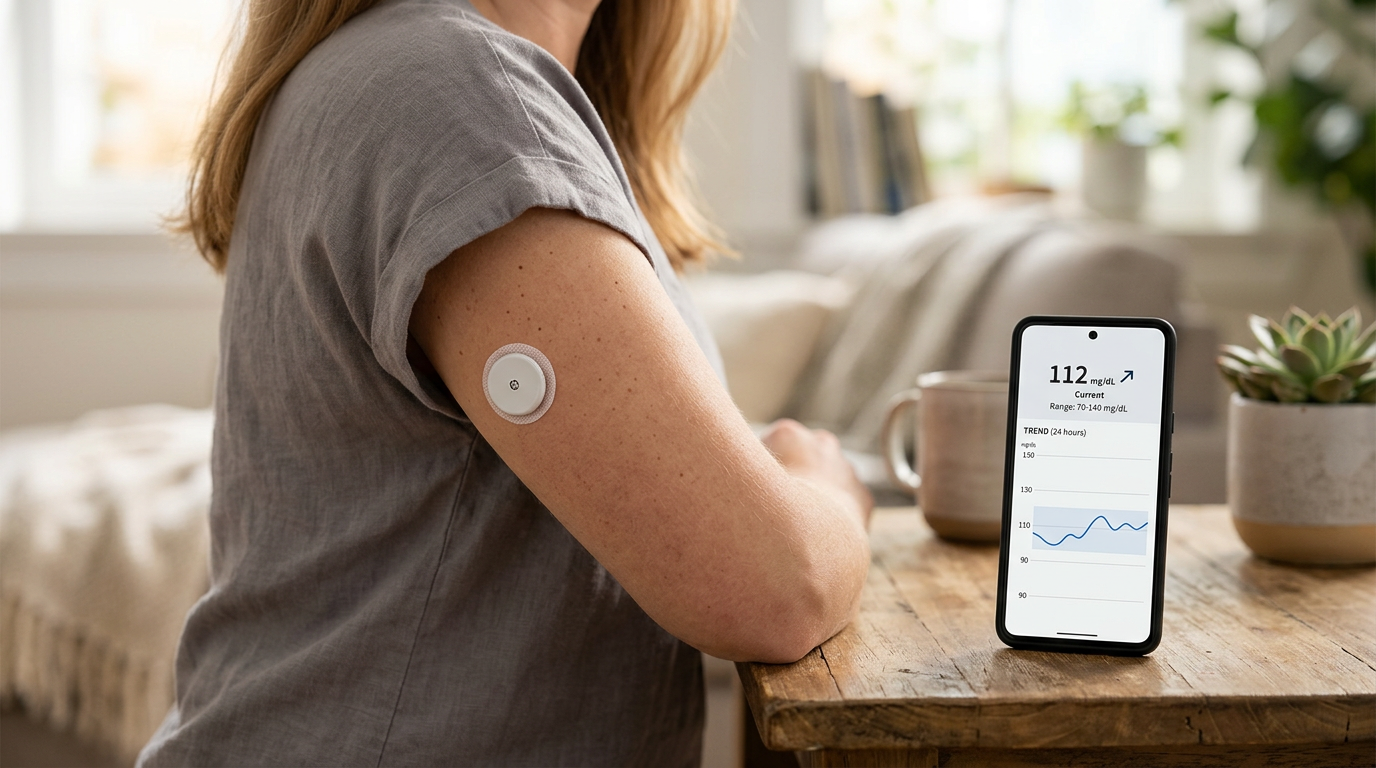
First, let's be clear about what these devices do. A continuous glucose monitor (CGM) measures your blood sugar (glucose) in real-time, 24/7. It uses a tiny sensor under your skin that reads glucose in your interstitial fluid.
That's it. That's all it measures.
Now here's where things get interesting. Glucose is not "metabolic health." Glucose is one data point. One. Your body regulates blood sugar constantly — that's what it's supposed to do. Having normal glucose readings doesn't mean you're metabolically healthy. Having variable glucose doesn't mean you're not.
The CGM companies want you to think otherwise. We'll get to that.
Who Actually Benefits
There are people who genuinely benefit from wearing a CGM:
Pre-diabetics. If your doctor has told you you're pre-diabetic or at risk for type 2 diabetes, a CGM can be genuinely useful. You can see how your body responds to different foods, and make informed decisions.
People with insulin resistance suspicion. If you have symptoms — constant fatigue, weight gain around the middle, cravings — and your doctor hasn't been helpful, CGM data can give you evidence. Something to bring to a real conversation.
Data-driven experimenters. Some people genuinely enjoy the data. They like seeing patterns. If that's you, and you have the money, nobody's stopping you.
Athletes optimizing nutrition timing. Endurance athletes and serious competitors can use CGM to fine-tune pre-, during-, and post-workout fueling. Knowing your individual glucose response to different carb sources helps optimize race-day nutrition.
That's the list. It's shorter than the influencers would have you believe.
Who Doesn't Benefit
Healthy people with normal metabolism. That's most of us.
If you're generally healthy, eat a reasonable diet, exercise, and sleep well — a CGM is unlikely to tell you anything useful. Your glucose is doing what it's supposed to do. The "spikes" you see after meals? That's normal. That's how bodies work.
And here's the real problem: the "glucose anxiety" that comes from watching your numbers all day. When normal fluctuations feel like failures. When you start avoiding perfectly healthy foods because they caused a "spike." That's not optimization. That's an eating disorder dressed up as biohacking.
What Does the Research Say?
The evidence for CGM use in non-diabetic populations is thin but growing.
Glucose variability in healthy people:
- A 2018 study in PLOS Biology (Hall et al.) attached CGMs to 57 healthy participants and found significant individual variation in glucose responses to identical meals. Some people spiked from rice but not pasta; others showed the opposite pattern. This suggests food recommendations shouldn't be one-size-fits-all — but it doesn't mean everyone needs a CGM to figure it out.
CGM accuracy:
- CGMs measure interstitial fluid glucose, not blood glucose. There's a 5-15 minute lag, and accuracy varies. A 2020 Diabetes Technology & Therapeutics study found that consumer CGMs had a mean absolute relative difference (MARD) of 9-14% compared to blood glucose meters. Good enough for trends, not precise enough to obsess over individual readings.
Does seeing data change behavior?
- A 2023 review in Nutrients found that CGM-based feedback led to modest dietary improvements in non-diabetic users — mainly reduced refined carb intake. But the effect diminished after the novelty wore off (typically 2-4 weeks). Most people don't need a $150/month sensor to tell them that donuts spike their blood sugar.
The bottom line on evidence: CGM can provide interesting individual insights, but for healthy people, the clinical utility is unproven. For a deeper dive into glucose metrics, see our glucose variability guide.
Browse All Products
Explore our evidence-based product reviews across every health category.
The Cost
Let's talk money.
- Dexcom Stelo: ~$99/month (no prescription required — the first OTC CGM from Dexcom, available since 2024)
- Levels Health: ~$150-200/month (includes app platform and coaching)
- Nutrisense: ~$100-150/month (includes dietitian coaching)
- Abbott Lingo: ~$49-99/month (consumer-focused, no prescription needed)
- Signos: ~$150-200/month (includes weight management coaching)
That's $600-2,400 per year. For data you could get from a $15 blood test once a year.
The Dexcom Stelo is worth highlighting — it's the first CGM from a major manufacturer designed specifically for non-diabetics, available over the counter without a prescription. At ~$99/month, it's the most straightforward option if you just want to try CGM without a coaching subscription bundled in.
For a complete comparison of all these options, see our full ranking of the best CGMs for non-diabetics in 2026.
The Better Alternative
Here's what actually makes sense for most people:
Get an HbA1c test. It measures your average blood sugar over 2-3 months. It's the gold standard for understanding metabolic health. It costs about $15-30 without insurance. You can get it done at any lab.
Get basic metabolic bloodwork. Fasting glucose, insulin, lipid panel. These together tell you way more than a CGM ever could. And you do it once a year.
Work with a functional medicine doctor if you have real concerns. Not an influencer. An actual medical professional who can interpret real data in context.
What About Levels and Nutrisense?
We've reviewed both. Here's the honest take:
Levels Health gives you the CGM plus access to their platform that interprets your data. The coaching is hit-or-miss. Some people love it. Some people get generic advice. You're paying for the subscription, not necessarily the expertise.
Nutrisense is similar — CGM plus nutrition coaching. Again, coaching quality varies. You're not getting a personalized medical team. You're getting someone with a computer program.
Neither is bad. Neither is magic. Neither is worth the hype.
The Verdict
If you're pre-diabetic or have genuine metabolic concerns, talk to your doctor first. Get the real tests. See if a CGM makes sense as part of a plan.
If you're healthy and just curious? Try a single month of Dexcom Stelo or Levels to satisfy your curiosity — you'll learn your personal glucose patterns within 2-4 weeks. After that, save your money. Eat real food. Exercise. Sleep. Your body is already optimizing itself. You don't need to watch it happen in real-time.
The best biohack isn't a device. It's consistent habits over time.
Get smarter about health tech
Deal alerts, new reviews, and health tips — delivered weekly. No spam.
Unsubscribe anytime. We respect your inbox.
A Practical Framework: When to Try CGM
If you're still on the fence, here's a practical decision framework:
Try a 1-month CGM experiment if:
- You have a family history of type 2 diabetes and want to understand your personal glucose patterns
- You're an endurance athlete preparing for a race and want to optimize fueling strategy
- You've already done standard bloodwork and want to see how specific meals affect you
- You understand the data is directional, not diagnostic
Skip CGM entirely if:
- Your HbA1c and fasting glucose are normal and you have no risk factors
- You tend toward anxious, perfectionist thinking around food
- You're not willing to make dietary changes based on the data — there's no point in paying to watch numbers if you won't act on them
- Your primary goal is weight loss — CGM doesn't address the caloric balance equation
The one-month test: If you decide to try, commit to exactly one month. Use it to identify your top 3-5 food triggers, build a personal "best of" meal list, and then stop. The ongoing subscription after that is rarely worth it for healthy people.
Quick Summary
| Who should get one? | Who shouldn't? |
|---|---|
| Pre-diabetics | Healthy people without symptoms |
| Insulin resistance suspects | Anyone prone to food anxiety |
| Athletes optimizing fueling | People expecting a weight loss tool |
| People working with a doctor | Anyone not willing to act on the data |
FAQ
Does CGM help with weight loss?
Not directly. It can show you how foods affect your glucose, but that doesn't automatically translate to weight loss. Awareness isn't the same as action.
Can I use CGM without a prescription?
Yes — the Dexcom Stelo and Abbott Lingo are available over the counter without a prescription. Other CGMs like Dexcom G7 and Libre 3 still require prescriptions for ongoing use, though some telehealth services bundled with Levels and Nutrisense can provide them.
How accurate are CGMs?
They're reasonably accurate for trending but not as precise as finger-prick tests. Studies show a 9-14% mean absolute relative difference (MARD) compared to blood glucose meters. Expect some lag and variance — don't panic over individual readings.
Will a CGM tell me if I'm diabetic?
No. That's what HbA1c and fasting glucose tests are for. CGM shows trends, not diagnoses.
Is CGM data useful for athletes?
Some athletes use CGM to optimize nutrition timing, but the data is highly individual. Endurance athletes training for races may benefit from understanding their glucose response to different fueling strategies. Most recreational athletes don't need it.
Should I get a CGM just to "optimize" my diet?
For most healthy people, no. The data won't tell you anything actionable that you couldn't learn from basic bloodwork and listening to your body. If you're genuinely curious, try a single month to learn your patterns, then stop.
Featured Products
Products mentioned in this article


Related Guides
More articles you might find helpful
How to Regulate Blood Sugar Naturally: Evidence-Based Strategies
Your body regulates blood sugar constantly. It's one of the most fundamental things your metabolism does. But modern life — processed foods, sedentary habits, chronic stress — can throw that system out of whack.
Cold Plunge Benefits: What the Science Actually Says
Cold plunging is having a moment. Every biohacker's Instagram shows ice baths, cold plunge pools are popping up in gyms, and Andrew Huberman's podcast made it mainstream.
How Does Sleep Affect Longevity? What the Science Actually Says
The connection between sleep and lifespan isn't subtle. It's not some hippy-dippy wellness claim. The data is stark: people who consistently sleep less than 6 hours per night have a 12-15% higher risk of dying from any cause compared to those sleeping 7-8 hours. As an illustrative comparison, some r

Written by
Steve Luu
Health tech researcher