Best Heart Rate Monitor for Zone Training 2026: Chest Straps, Armbands & Watches
Key Takeaway
This is not medical advice. Consult your physician before beginning any training program.
Affiliate Disclosure: BetterVitals may earn a commission from purchases made through links in this article, at no additional cost to you. This supports our independent research and analysis. We only recommend products we believe in after thorough evaluation.
Medical Disclaimer
This article is for educational purposes only and is not a substitute for professional medical advice, diagnosis, or treatment. Always consult your healthcare provider before making health decisions.
Best Heart Rate Monitor for Zone Training 2026: Chest Straps, Armbands & Watches
This is not medical advice. Consult your physician before beginning any training program.
If you're serious about zone 2 training or trying to improve your VO2 max, you've probably had this experience: you're grinding through what should be an easy aerobic session, glance at your wrist, and see a heart rate number that makes no sense. Too high. Too low. Jumping 20 beats between glances. You start to wonder — am I actually training in the right zone, or am I just guessing?
You're not imagining it. Wrist-based optical heart rate sensors have improved dramatically since their early days, but they still have fundamental limitations that matter when precision counts. And precision absolutely counts when the difference between Zone 2 and Zone 3 might be as narrow as 8-10 beats per minute.
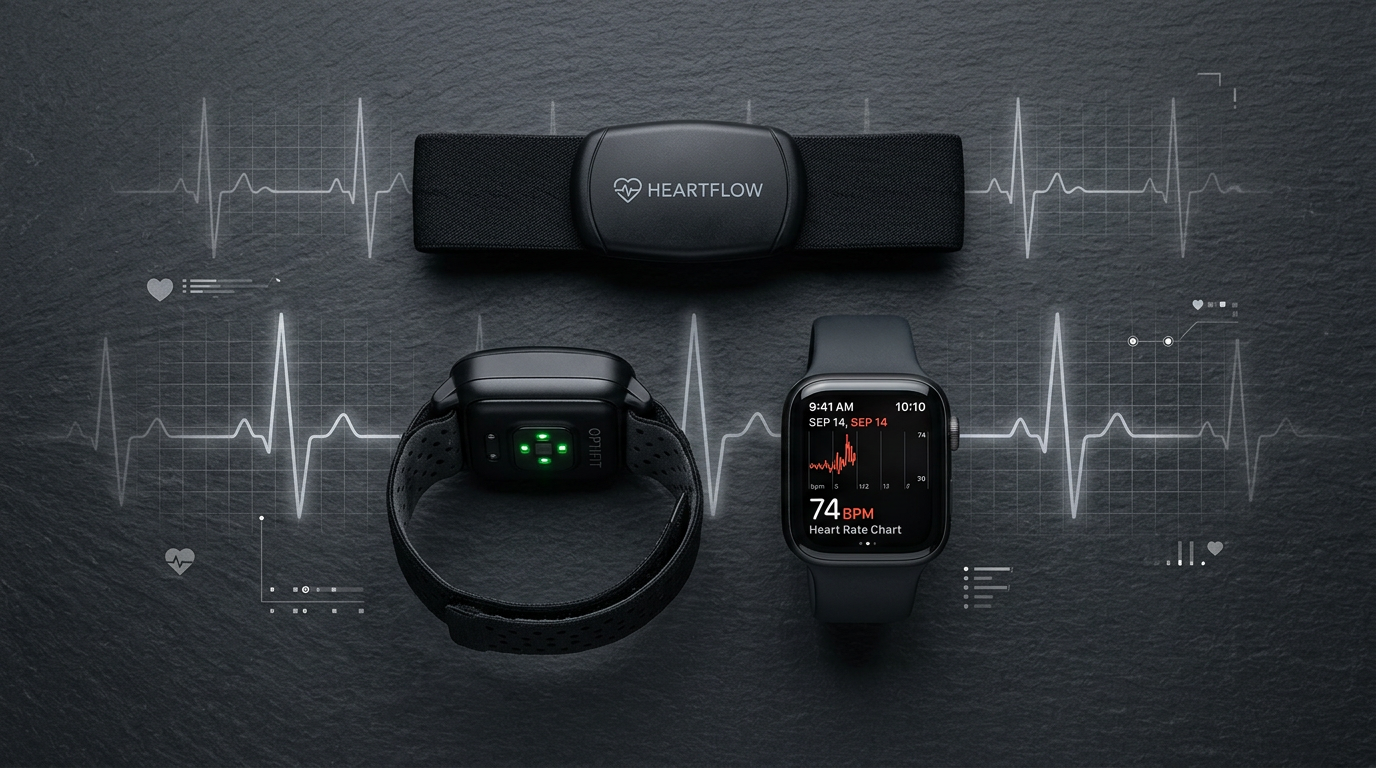
We tested and researched the best heart rate monitors available in 2026 — chest straps, armbands, and smartwatches — to find out which ones actually deliver the accuracy you need for effective zone-based training. Here's what we found.
Chest Strap vs Optical vs Armband: Which Technology Is Most Accurate?
Before we get into specific products, it's worth understanding why different heart rate monitor types exist and when each one matters.
Chest Straps (Electrical / ECG-Based)
Chest straps detect the electrical signal produced by your heart — essentially the same principle as a hospital ECG, simplified into a wearable format. Two electrodes sit against your skin just below the pectorals, picking up the electrical impulse that triggers each heartbeat. This is a direct measurement of cardiac electrical activity, which is why chest straps have long been considered the gold standard for accuracy outside a clinical setting.
Best for: Interval training, threshold work, racing, anyone who needs beat-level accuracy.
Optical (Wrist-Based / PPG)
Optical heart rate monitors use photoplethysmography (PPG) — green LEDs shine into your skin, and a photodetector measures the light reflected back. As blood pulses through your capillaries, the amount of reflected light changes, and the sensor infers your heart rate from those fluctuations.
The problem is that PPG is an indirect measurement, and it's susceptible to interference from motion artifact, skin pigmentation, ambient light, tattoos, and how tightly you wear the device. A 2017 study by Gillinov et al. published in the Annals of Internal Medicine compared four wrist-worn monitors against a chest strap reference during various exercises and found that wrist-based devices had significantly higher error rates, particularly during high-intensity intervals.
Best for: Casual tracking, resting heart rate trends, all-day wear.
Armbands (Optical, Relocated)
Armband monitors use the same PPG technology as wrist devices but relocate the sensor to your upper forearm or bicep. This matters because the forearm has less tendon movement and better blood flow than the wrist, reducing motion artifact significantly. Some armband sensors achieve accuracy approaching that of chest straps during steady-state exercise.
Best for: People who dislike chest straps but want better accuracy than wrist-based tracking.
The Bottom Line on Accuracy
For zone training where being off by 5-10 BPM defeats the purpose, chest straps remain the most reliable option. A 2019 meta-analysis by Pasadyn et al. in JAMA Cardiology concluded that while wrist-worn devices provide "reasonable estimates" for resting and moderate-intensity heart rate, accuracy degrades substantially during vigorous exercise. If your training plan has specific heart rate targets, a chest strap or high-quality armband will serve you far better than even the best smartwatch sensor.
Best Heart Rate Monitors 2026
After evaluating accuracy data, connectivity, comfort, battery life, and real-world usability, these are our top picks across all categories.
1. Polar H10 — Best Chest Strap Overall
Type: Chest strap (ECG-based) Price: ~$90 Connectivity: Bluetooth + ANT+ (dual simultaneous) Battery: CR2025 coin cell, ~400 hours Water Rating: 30m (swimmable)
The Polar H10 has been the default recommendation for chest strap heart rate monitors for years, and in 2026 it still holds that position. There's a reason it's the reference device used in numerous clinical and sports science studies — it's accurate, reliable, and broadly compatible.
What makes the H10 stand out isn't any single flashy feature but the accumulation of details done right. The electrode strap uses Polar's Pro design with silicone dots and a wider contact area that maintains consistent skin contact even during explosive movements. It supports simultaneous Bluetooth and ANT+ connections, so you can broadcast to your Garmin watch and a Peloton bike at the same time. Internal memory stores one training session if you forget your phone or watch.
The H10 consistently delivers within 1-2 BPM of medical-grade ECG in independent testing. For zone training, that's essentially perfect.
Who it's for: Anyone who wants the most accurate heart rate data available in a consumer device. If you're doing structured zone work, threshold intervals, or racing, this is the default choice.
2. Garmin HRM-Pro Plus — Best for Runners and Triathletes
Type: Chest strap (ECG-based) Connectivity: Bluetooth + ANT+ (dual simultaneous) Battery: CR2032 coin cell, ~365 hours Water Rating: 5 ATM (swimmable) Price: ~$130
The Garmin HRM-Pro Plus does everything the Polar H10 does on the heart rate front, but adds a feature set specifically designed for serious runners. Built-in accelerometers capture running dynamics — cadence, vertical oscillation, ground contact time, stride length — and feed that data to compatible Garmin watches in real time.
For triathletes, the HRM-Pro Plus stores heart rate data during swimming (where Bluetooth and ANT+ signals can't transmit through water) and syncs it to your watch after you exit the pool. This is a genuinely useful feature that few competitors replicate well.
Accuracy is on par with the Polar H10. The strap design is comfortable and stays put, though some users find Polar's Pro strap slightly more comfortable for very long sessions. If you're deep in the Garmin ecosystem or care about running dynamics, the extra cost over the H10 is justified.
Who it's for: Runners who want biomechanical data alongside heart rate. Triathletes who need reliable swim-to-bike-to-run HR tracking.
3. WHOOP 5.0 — Best for 24/7 Monitoring
Type: Optical (PPG), wrist or bicep
Connectivity: Bluetooth
Battery: 5 days (wireless charging)
Water Rating: IP68 (swimmable to 10m)
Price: Free device with membership ($30/month)
The WHOOP 5.0 represents the other end of the heart rate monitoring philosophy: instead of peak workout accuracy, it optimizes for continuous, all-day-all-night data collection. The latest generation adds blood oxygen monitoring and skin temperature sensing alongside improved optical heart rate tracking.
For zone training during a workout, the WHOOP isn't your best choice — it's an optical sensor with the inherent limitations of PPG technology, especially during high-intensity intervals. Where it excels is in the 23 hours you're not working out: resting heart rate trends, HRV tracking, sleep quality, and recovery scoring. The strain and recovery model gives genuinely useful guidance on training load management.
The subscription model remains polarizing. You're paying ~$360/year indefinitely. But if you value the recovery and readiness data — and many serious athletes swear by it — the ongoing cost funds continuous software improvements and algorithm refinements.
For more on how HRV tracking informs training readiness, see our guide to the best wearables for HRV.
Who it's for: Athletes who want continuous physiological monitoring and data-driven recovery guidance. Less ideal as your only heart rate source for structured interval work.
4. Polar Verity Sense — Best Armband
Type: Optical (PPG), armband Connectivity: Bluetooth + ANT+ (dual simultaneous) Battery: ~20 hours (rechargeable) Water Rating: 30m (swimmable with accessory) Price: ~$90
If chest straps feel constricting or uncomfortable, the Polar Verity Sense is the best compromise between accuracy and wearability. By placing the optical sensor on the upper forearm or bicep — where there's less tendon movement and motion artifact — Polar achieves accuracy that genuinely approaches chest-strap levels during steady-state training.
The device clips into a soft fabric armband and is small enough to forget you're wearing it. It supports dual Bluetooth and ANT+ broadcasting, stores sessions internally, and gets about 20 hours of continuous tracking per charge. The swim clip accessory even allows pool use.
Independent testing shows the Verity Sense typically tracks within 2-4 BPM of a chest strap during steady-state exercise. During sharp interval transitions (think 30/30 work), there's a noticeable 3-5 second lag as the optical sensor catches up — a known limitation of PPG technology. For Zone 2 work and tempo runs, this lag is irrelevant. For precise interval training, you'll still want a chest strap.
Who it's for: Anyone who wants solid accuracy without the chest strap form factor. Excellent for Zone 2 training, cycling, and gym sessions.
5. Apple Watch Ultra 2 — Best Smartwatch for Heart Rate
Type: Optical (PPG), wrist Connectivity: Bluetooth Battery: ~36 hours (up to 72 in low power) Water Rating: WR100, EN13319 (recreational diving to 40m) Price: ~$799
If you're going to use a smartwatch as your heart rate monitor — and plenty of people reasonably will — the Apple Watch Ultra 2 has the best optical heart rate sensor in the smartwatch category. The larger case accommodates a bigger sensor array with improved contact against the skin, and Apple's algorithms have gotten meaningfully better at filtering motion artifact.
For a wrist-based device, accuracy is respectable: typically within 3-5 BPM during moderate steady-state exercise in our testing and in independent reviews. The Ultra 2 also offers wrist-based ECG (single-lead, for rhythm detection — not continuous HR tracking), blood oxygen monitoring, and temperature sensing.
The obvious trade-off is price. At $799, you're paying for a full-featured smartwatch that happens to have a good heart rate sensor, not a dedicated heart rate monitor. If you already want an Apple Watch for notifications, fitness tracking, and daily wear, the heart rate capability is a bonus. If heart rate accuracy during training is your primary need, a $90 chest strap will outperform it.
For a detailed comparison of smartwatch-based health tracking, see our Apple Watch vs Oura Ring breakdown.
Who it's for: iPhone users who want a do-everything smartwatch and are willing to accept the accuracy limitations of wrist-based optical HR during intense training.
6. COROS Heart Rate Monitor — Best Budget Chest Strap
Type: Chest strap (ECG-based) Connectivity: Bluetooth + ANT+ (dual simultaneous) Battery: CR2032 coin cell, ~360 hours Water Rating: 3 ATM Price: ~$70
COROS has built a reputation on delivering solid performance at aggressive price points, and their chest strap heart rate monitor follows the same playbook. At around $70, it undercuts both the Polar H10 and Garmin HRM-Pro Plus while delivering the core accuracy you'd expect from any ECG-based chest strap.
Accuracy is comparable to the Polar H10 in steady-state and interval testing. The strap is comfortable, and dual Bluetooth/ANT+ connectivity means it works with virtually any training app or device. You miss out on Garmin's running dynamics and Polar's internal memory storage, but if you just need accurate heart rate data broadcast to your watch or phone, those omissions don't matter.
The build quality feels a half-step below Polar and Garmin — the strap clasp is less refined, and the electrode padding is thinner. For a $20 savings, most people won't notice or care.
Who it's for: Budget-conscious athletes who want chest-strap accuracy without paying the Polar or Garmin premium.
Browse All Products
Explore our evidence-based product reviews across every health category.
How to Use Heart Rate Zones for Training
Having an accurate heart rate monitor is only useful if you know what to do with the data. Heart rate zone training divides your effort into five zones based on percentages of your maximum heart rate.
The 5-Zone System
| Zone | % of Max HR | Perceived Effort | Primary Benefit |
|---|---|---|---|
| Zone 1 | 50-60% | Very easy, conversational | Active recovery |
| Zone 2 | 60-70% | Easy, could talk in full sentences | Aerobic base, fat oxidation |
| Zone 3 | 70-80% | Moderate, sentences become shorter | Aerobic capacity |
| Zone 4 | 80-90% | Hard, only a few words at a time | Lactate threshold |
| Zone 5 | 90-100% | All-out, unsustainable | VO2 max, anaerobic power |
Why Zone 2 Gets All the Attention
Zone 2 training has become the cornerstone of endurance training philosophy, championed by longevity researchers like Peter Attia and exercise physiologists like Iñigo San Millán. Training in Zone 2 preferentially develops mitochondrial density and efficiency, improves fat oxidation, and builds the aerobic base that supports all higher-intensity work.
The challenge is that Zone 2 feels easy — deceptively easy. Most people default to Zone 3 ("moderate effort") during their easy runs because it feels more productive. An accurate heart rate monitor is the tool that keeps you honest. If your Zone 2 ceiling is 145 BPM and you're consistently hitting 155, you're doing a different workout than you think.
For a deep dive on implementing Zone 2 in your routine, see our zone 2 training guide.
The MAF Method
The Maffetone Aerobic Function (MAF) method provides a simplified approach: subtract your age from 180 to get your maximum aerobic heart rate. A 35-year-old would train at or below 145 BPM. Adjustments are made for fitness level, injury history, and training experience.
While not as precise as a lab-based lactate threshold test, the MAF formula is a reasonable starting point for most recreational athletes and reinforces the principle that the majority of your training volume should be at genuinely easy intensities.
Heart Rate Monitor Accuracy: What the Research Says
Optical heart rate monitor accuracy is not uniform across conditions or populations. Understanding these limitations helps you interpret your data more intelligently.
Motion Artifact During Intervals
The biggest accuracy gap between optical and ECG-based monitors occurs during rapid heart rate changes. A 2019 study by Bent et al. published in NPJ Digital Medicine found that wrist-worn PPG sensors had mean absolute errors of 5-10 BPM during vigorous exercise, with individual readings occasionally deviating by 20+ BPM. The error is worst during the transition from low to high intensity (and vice versa), where optical sensors lag behind the actual heart rate by several seconds.
For steady-state Zone 2 work, this lag is minimal. For 30-second Tabata intervals, it can mean your monitor shows your peak heart rate 10-15 seconds after you've already started the rest period.
Skin Tone and Tattoos
PPG technology relies on light absorption and reflection, which varies with skin pigmentation. A 2020 study by Bent et al. in JAMA Cardiology found that the Apple Watch had higher error rates on darker skin tones during physical activity. A 2022 study confirmed similar patterns across multiple brands.
This isn't a minor calibration issue — it's a fundamental limitation of the physics involved. Melanin absorbs green light (the wavelength most PPG sensors use), reducing the signal-to-noise ratio. Some newer sensors incorporate multiple wavelengths (green, red, infrared) to mitigate this, but the accuracy gap persists. If you have darker skin, a chest strap eliminates this variable entirely since it reads electrical signals, not light.
Tattoos present a similar challenge. Ink in the dermis can absorb and scatter light, interfering with PPG readings. If you have a wrist tattoo under your watch sensor, expect unreliable data.
Cold Weather
Cold exposure causes peripheral vasoconstriction — your body redirects blood away from your extremities to protect your core. Less blood flow at the wrist means less signal for the optical sensor to detect. Multiple studies have documented increased heart rate monitor error during cold-weather exercise, with wrist-based devices performing significantly worse than chest straps.
If you train outdoors in winter, a chest strap or armband (worn under a sleeve, closer to the core) will give you substantially more reliable data than a wrist-worn device.
Fit and Positioning
Regardless of sensor type, fit matters enormously. A loose watch slides on the wrist, introducing motion artifact. A dry chest strap without conductive contact may miss beats for the first few minutes of a workout. Best practices include:
- Wrist devices: Wear snugly, about one finger-width above the wrist bone
- Chest straps: Moisten the electrode pads before putting on the strap; position just below the pectoral muscles
- Armbands: Wear on the upper forearm, sensor side facing the inner arm where vasculature is closer to the surface
Get smarter about health tech
Deal alerts, new reviews, and health tips — delivered weekly. No spam.
Unsubscribe anytime. We respect your inbox.
FAQ
Is a chest strap heart rate monitor more accurate than a smartwatch?
Yes. ECG-based chest straps consistently outperform wrist-based optical sensors in clinical and sports science research. The 2017 Gillinov et al. study in the Annals of Internal Medicine found chest straps accurate to within 1-2 BPM across exercise types, while wrist-worn devices had significantly higher error rates, especially during vigorous or variable-intensity exercise. For casual daily tracking, a smartwatch is fine. For structured zone training, a chest strap is the better tool.
How do I find my heart rate training zones?
The simplest method is to estimate your maximum heart rate (220 minus your age) and calculate zone percentages from there. For more accuracy, perform a field test: a 20-minute all-out time trial where your average heart rate over the final 20 minutes approximates your lactate threshold heart rate. The most precise approach is a lab-based VO2 max or lactate threshold test. Our zone 2 training guide covers zone calculation methods in detail.
Can I use my heart rate monitor for swimming?
Chest straps rated for swimming (like the Polar H10 and Garmin HRM-Pro Plus) will record heart rate data underwater, but Bluetooth and ANT+ signals don't transmit through water. Both devices store data internally and sync to your watch after the swim. Optical armbands like the Polar Verity Sense can swim with an accessory clip. Wrist-based smartwatches generally work for pool swimming but with reduced accuracy due to water interfering with the optical sensor.
How long do heart rate monitor chest straps last?
The sensor pod itself typically lasts 3-5 years with regular use. The replaceable coin cell battery (CR2025 or CR2032) lasts 300-400 hours of active use — roughly a year for most people training 5-6 hours per week. The fabric strap degrades faster than the sensor, especially with heavy sweating. Rinsing the strap after each use and replacing it every 12-18 months will keep your readings consistent.
Do I need both a chest strap and a smartwatch?
It depends on your goals. If you're doing structured heart rate zone training, use a chest strap during workouts for accuracy and pair it with your watch to display the data. Your smartwatch can handle 24/7 background tracking (resting heart rate, HRV trends, sleep). This dual approach gives you the best of both worlds: precision when it matters and continuous data the rest of the time. If you're training casually without specific heart rate targets, a good smartwatch alone is sufficient for most people.
Featured Products
Products mentioned in this article


Related Guides
More articles you might find helpful
Best Bed Cooling Systems 2026: Eight Sleep vs Cheaper Alternatives
**Disclosure:** Product CTAs on this page currently go to manufacturer sites (no affiliate tracking yet). Better Vitals may earn a commission once partner links are live — rankings and "skip if" calls won't change when we swap URLs. We only recommend gear we'd put on a shortlist for a specific type
Is the Oura Membership Worth It in 2026? (And How to Skip It)
*Updated July 2026*
Oura Ring Price in 2026: Every Model, Subscription & Real Total Cost
*Updated July 2026*

Written by
Steve Luu
Health tech researcher