Signos Review 2026: CGM for Weight Loss, Tested
Key Takeaway
Updated July 2026

Affiliate Disclosure: BetterVitals may earn a commission from purchases made through links in this article, at no additional cost to you. This supports our independent research and analysis. We only recommend products we believe in after thorough evaluation.
Medical Disclaimer
This article is for educational purposes only and is not a substitute for professional medical advice, diagnosis, or treatment. Always consult your healthcare provider before making health decisions.
Signos Review 2026: CGM for Weight Loss, Tested
Meta description: Signos review: how the AI turns Dexcom CGM data into real-time weight-loss nudges, what it costs, and who should pick Stelo or Nutrisense instead.
Updated July 2026
Verdict up front: Signos is the only CGM program purpose-built for weight loss, and its core trick genuinely works — real-time AI nudges ("walk now," "your glucose is dropping, good window to eat") that turn glucose data into in-the-moment decisions instead of after-the-fact charts. At ~$179/month it's nearly double Dexcom Stelo, so the same test applies as with every premium CGM program: if weight loss is your explicit goal and you'll act on prompts, it earns the premium. For general metabolic curiosity, it doesn't.
What Is Signos?
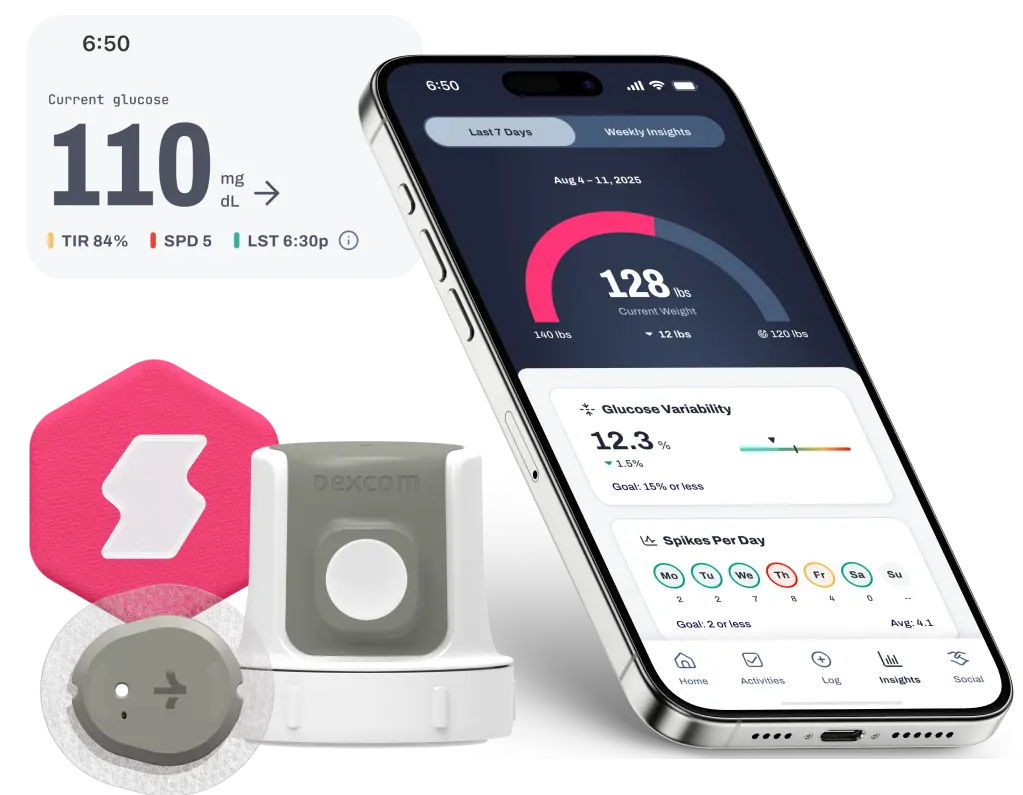
Signos pairs Dexcom sensor hardware (Stelo/G7-based, so accuracy matches the best in class) with an AI engine trained on one outcome: weight loss. The theory is grounded in real metabolic science — stable glucose reduces cravings and supports fat oxidation; spikes followed by crashes drive hunger — and Signos operationalizes it by learning your responses and prompting you at decision moments.
No prescription required; a brief in-app health review covers eligibility.
Worth stating plainly, because Signos' marketing won't: for people without diabetes, a CGM is an educational and behavioral tool, not a medical treatment. Glucose responses are highly individual — the food that spikes you may not spike someone else — which is the entire premise of personalizing to your data, but it also means nobody can promise you a specific outcome. If you have a suspected metabolic condition, start with a physician and labs, not a subscription.
How the AI Coaching Actually Works
Where Levels and Stelo show you what happened, Signos tells you what to do now:
- Post-meal spike detected → prompt to take a 10–15 minute walk, with a countdown of the optimal window
- Glucose stable and trending down → "good time to eat" — the signal most dieters never have, replacing clock-driven meals with physiology-driven ones
- Pattern learning → after a few weeks it knows your personal spike foods and starts warning you before repeat offenses at logged meals
- Apple Watch integration puts prompts on your wrist, which matters — the moment passes if the advice lives in a phone you're not holding
In our test the walk prompts were the sleeper hit: trivially easy to comply with, visibly flattened the curve every time, and became habitual within two weeks. That's the product working as designed — manufacturing small compliant moments that compound.
What the First Month Actually Looks Like
Expect the program to unfold in phases rather than deliver instant advice:
- Days 1–2: Apply the Dexcom-based sensor to the back of your arm (the applicator makes it painless), complete the in-app onboarding, and ignore day-one readings — every CGM platform is noisiest in its first 12–24 hours of wear.
- Weeks 1–2: calibration. The AI is learning your baseline, your typical meal responses, and your daily rhythm. Prompts start generic and get sharper as it accumulates your data. Eat normally during this window — the system needs to see the real you, not the best-behavior you.
- Weeks 3–4: the payoff phase. Prompts become personal — pre-emptive warnings about your logged trigger foods, eating-window suggestions tuned to your curves. This is also when you should tune notification settings, because the default volume of nudges is high.
Day-to-day overhead is low: sensors survive showers and workouts, meal logging is optional but sharpens the AI, and the main habit is simply acting on the wrist prompts. Two ubiquitous CGM quirks to expect: false lows overnight if you sleep on the sensor arm (a pressure artifact), and a 5–15 minute lag behind blood glucose because sensors read interstitial fluid. Neither matters for the use case.
What the Evidence Supports
Signos runs its own IRB-approved research and publishes observational results showing meaningful average weight loss among engaged users. Independent randomized evidence for CGM-guided weight loss in non-diabetics remains thin — the honest framing is that glucose-guided eating is a plausible and behaviorally clever mechanism, not a clinically proven superior one. The walking-after-meals piece has solid independent evidence behind it regardless.
Also honest: much of what Signos teaches converges on advice you could follow for free — walk after meals, pair carbs with protein and fiber, don't graze on crash-driven hunger. Our glucose regulation guide covers the no-hardware version. What you're paying Signos for is personalization and timing: knowing which foods spike you specifically, and getting the prompt at the moment it's actionable. For some people that delivery mechanism is the difference between knowing and doing — that's the buyer Signos is built for.
Browse All Products
Explore our evidence-based product reviews across every health category.
Pricing
Signos runs ~$179/month with multi-month plans pricing lower and sensors included. HSA/FSA eligible.
| Signos | Nutrisense | Dexcom Stelo | |
|---|---|---|---|
| Monthly cost | ~$179 | $179–225 | $99 |
| Coaching | AI, real-time | Human dietitian | None |
| Built for | Weight loss | Broad behavior change | Raw data |
| Sensor | Dexcom-based | Libre-based, 14-day | Stelo, 15-day |
The Cost Math Over Time
A six-month run of Signos is roughly $1,000+; the same period on Stelo is about $600. Whether the ~$400+ delta is worth it depends entirely on whether the real-time prompting changes your behavior in a way raw data wouldn't — and you'll know the answer within the first month or two, because either you're acting on the nudges or you're swiping them away.
Our suggested structure: commit to three months minimum (the AI needs weeks one and two just to calibrate, so a single month undersells the product), then reassess honestly. If the habits have stuck — the post-meal walks, the reordered meals, the physiology-driven eating windows — you may no longer need the prompt engine that installed them, and a cheaper sensor or no sensor at all maintains the gains. Paying $179/month indefinitely for habits you've already built is the failure mode to avoid.
What We Don't Like
- Single-purpose. If weight isn't the goal, the AI's advice adds little over Stelo's raw data at nearly double the cost.
- Prompt fatigue is real. Expect to tune notification settings by week two.
- AI ceiling. The nudges are good at when; a human dietitian is better at why and at untangling emotional and contextual eating — that's Nutrisense's territory.
Who Should Buy Signos?
- Weight loss is the explicit, primary goal and previous calorie-focused approaches haven't stuck
- You respond well to prompts — the product is literally a nudge engine; know your own psychology
- Apple Watch wearers who'll see the prompts in time to act
Choose Dexcom Stelo if you just want the data at half the price, or Nutrisense if you want human coaching. Full rankings in our best CGMs for non-diabetics guide.
Get smarter about health tech
Deal alerts, new reviews, and health tips — delivered weekly. No spam.
Unsubscribe anytime. We respect your inbox.
Who Should Skip It
- General metabolic curiosity. If you just want to see your glucose, a $49–99 sensor-only option answers the question at a fraction of the price.
- Notification-averse people. Signos is its notifications. If you already silence your watch, you're buying the product minus its mechanism.
- Anyone with a history of disordered eating. Real-time prompts about when to eat and continuous body-data feedback can reinforce restriction and food anxiety — this category of product is genuinely contraindicated for that history.
- People whose overeating is emotional or contextual. A nudge engine can't untangle stress eating; a human dietitian (or therapist) can.
- Insulin users — Signos isn't built for insulin dosing; that requires a prescription CGM with alarms.
Bottom Line
Signos is the most opinionated product in the CGM category, and that's its strength: it picked one outcome — weight loss — and built the only real-time intervention engine around it. The mechanism is behaviorally smart, the Dexcom hardware is best-in-class, and the walk prompts alone changed our behavior measurably. But it's a premium tool for a narrow job. Buy it if weight loss is your explicit goal, you wear an Apple Watch, and you know yourself to be prompt-responsive; run it for three focused months and let it install habits. Skip it if you want general glucose data (Stelo, at half the price) or human guidance (Nutrisense, at the same price) — and remember that no CGM program is a substitute for medical care if something feels genuinely wrong.
Frequently Asked Questions
Does Signos work for weight loss?
Signos' mechanism is behaviorally sound — real-time prompts that flatten glucose spikes (especially post-meal walks) reduce crash-driven hunger, and the company's own published observational data shows meaningful weight loss in engaged users. Independent randomized evidence is still limited, so treat it as a well-designed behavior tool, not a guaranteed outcome.
How much does Signos cost?
Around $179/month, with longer commitments pricing lower. Plans include Dexcom-based CGM sensors and the AI coaching platform, and it's HSA/FSA eligible. That's comparable to Nutrisense and nearly double sensor-only Dexcom Stelo at $99/month.
Signos vs Nutrisense: which is better for weight loss?
Signos — its AI is purpose-built for weight loss with real-time, act-now prompts, while Nutrisense's human dietitian is broader but asynchronous. Flip the answer if your eating challenges are emotional or contextual rather than timing-based: a human RD handles the why better than any nudge engine.
Does Signos require a prescription?
No. Signos ships Dexcom-based sensors after an in-app health review — no prescription needed. It's intended for adults without insulin-treated diabetes; insulin users need a prescription CGM with alarms instead.
Does Signos work with Apple Watch?
Yes, and it's the recommended setup — Signos' real-time prompts appear on the wrist, where you can actually act on them in the moment. Glucose readings and nudges sync to the watch alongside the iPhone app.
How long does it take to see results with Signos?
Plan on three months. The AI spends the first two weeks calibrating to your baseline, personalized prompts sharpen through weeks three and four, and habit formation — the actual weight-loss mechanism — plays out over the following months. Anyone promising visible results from two weeks of any glucose program is overselling.
Do I still need to count calories with Signos?
Signos doesn't require calorie counting — its model is timing and food-quality driven: eat when glucose is stable, blunt spikes with walks and meal composition. Energy balance still governs weight loss, though; Signos' bet is that stabler glucose reduces crash-driven overeating so the deficit happens more naturally. If tracking has worked for you before, the two approaches combine fine.
Does Signos work on Android?
Signos supports both iPhone and Android phones, but the real-time wrist prompts are strongest in the Apple Watch ecosystem, and that's the setup we tested and recommend. Android users still get all app notifications on their phone — check Signos' current device compatibility list before subscribing if you use a Garmin or other wearable.
Can you use Signos if you have diabetes?
Signos is designed for adults without insulin-treated diabetes; people with non-insulin type 2 should involve their physician before using any wellness CGM program alongside their care plan. Anyone using insulin needs a prescription CGM with urgent-low alarms — an OTC-based wellness program is not a safe substitute.
Disclaimer: This article contains affiliate links. We may earn a commission if you purchase through our links, at no additional cost to you. This content is not medical advice — consult your clinician before making decisions about glucose monitoring, weight loss, or diabetes care.
Featured Products
Products mentioned in this article

Related Guides
More articles you might find helpful
Eight Sleep Pod 5 Review 2026: Core vs Plus vs Ultra
**Disclosure:** Product CTAs on this page currently go to manufacturer sites (no affiliate tracking yet). Better Vitals may earn a commission once partner links are live — rankings and "skip if" calls won't change when we swap URLs. We only recommend gear we'd put on a shortlist for a specific type
Wonderfeel Youngr NMN Review 2026: 90-Day Results & Verdict
*Updated July 2026*
Nutrisense Review 2026: Is the Dietitian Add-On Worth $179/Month?
*Updated July 2026*

Written by
Steve Luu
Health tech researcher