Best Cold Plunge Tub of 2026: Reviewed by Temperature, Cost & Science | BetterVitals
Key Takeaway
Cold water immersion has gone from fringe biohacking to mainstream recovery practice — and for good reason. A landmark 2021 meta-analysis in the British Journal of Sports Medicine analyzing 99 studies found cold water immersion significantly reduces muscle soreness and perceived fatigue in the 24-
Affiliate Disclosure: BetterVitals may earn a commission from purchases made through links in this article, at no additional cost to you. This supports our independent research and analysis. We only recommend products we believe in after thorough evaluation.
Medical Disclaimer
This article is for educational purposes only and is not a substitute for professional medical advice, diagnosis, or treatment. Always consult your healthcare provider before making health decisions.
Best Cold Plunge Tub of 2026: Reviewed by Temperature, Cost & Science | BetterVitals
Cold water immersion has gone from fringe biohacking to mainstream recovery practice — and for good reason. A landmark 2021 meta-analysis in the British Journal of Sports Medicine analyzing 99 studies found cold water immersion significantly reduces muscle soreness and perceived fatigue in the 24-96 hours following exercise. But here's a number that might surprise you: the global cold plunge market grew by over 40% in 2024 alone, with consumer-grade home units now accounting for the majority of sales.
The problem is that "cold plunge tub" now describes everything from a $200 stock tank to a $5,000 temperature-controlled pod — and the differences are enormous. Temperature consistency, water filtration, setup complexity, and ongoing operating costs vary by orders of magnitude across the market. Using a non-chilled tub in summer means re-icing multiple times per session. Using an underpowered chiller means waiting an hour for water to reach target temperature. Using a unit without filtration means changing water every few days.
This guide cuts through the marketing to evaluate six leading cold plunge tubs across the criteria that actually determine the quality of your practice: temperature precision, filtration quality, ease of setup, operating cost, space requirements, and durability. For the science behind why cold exposure is worth the investment, see our full guide to cold plunge benefits. If you're deciding between heat and cold therapy, our sauna vs. cold plunge comparison covers both.
What to Look for in a Cold Plunge Tub
Temperature Range and Precision
The physiologically active window for cold water immersion is 50–59°F (10–15°C). Research from the University of Portsmouth shows that water below 59°F triggers the norepinephrine surge and anti-inflammatory cascade associated with cold therapy benefits. Below 50°F, the benefits plateau while discomfort and risk (cold shock response, hyperventilation) increase for most users.
What this means practically: you need a tub that can reliably reach and hold temperatures in this range, not just cool "somewhat cold" water. Non-chilled tubs (Ice Barrel, stock tanks) depend entirely on ambient temperature and ice — adequate in winter climates, inadequate in summer. Active chilling units (The Plunge, Morozko Forge) maintain set temperatures year-round with ±1–2°F precision.
Look for units that display actual water temperature in real-time, not just set-point temperature. The difference between 52°F and 58°F is significant for both comfort and protocol calibration.
Water Filtration and Sanitation
Stagnant water at 50–59°F is not cold enough to kill pathogens — it's actually an ideal incubation temperature for certain bacteria. Without filtration, a cold plunge tub requires complete water changes every 2–5 days, adding 200–500 gallons of water waste per week and making ownership impractical for many users.
Quality filtration systems combine three elements: mechanical filtration (removes particulate), UV sterilization (kills bacteria and algae without chemicals), and optional ozone or mineral sanitizers. The best units allow 2–4 weeks between water changes with routine salt or bromine maintenance. Cheap units with no filtration should factor water usage into their true cost of ownership.
Setup and Space Requirements
Cold plunge tubs range from 40 inches (Ice Barrel, designed for vertical immersion) to full-length soaking tubs at 84 inches. Most require proximity to a standard 110V or 220V outlet; chilling units typically draw 500–1,500 watts continuously. Factor in drainage access — units without a built-in drain require a pump or tipping to empty. Weight when filled ranges from 400 to 1,200+ lbs, making floor loading a real consideration for indoor installations.
Cost of Operation
The sticker price is only part of the equation. Monthly operating costs include electricity (chilling units run $15–50/month depending on climate and efficiency), water and chemicals ($5–20/month for sanitation), and filter replacement ($50–150/year). A $4,000 active chiller with $25/month in operating costs beats a $1,500 passive barrel requiring $40/month in ice and water changes over a two-year ownership period.
Best Cold Plunge Tubs of 2026
1. The Plunge Pro — Best Overall for Home Use
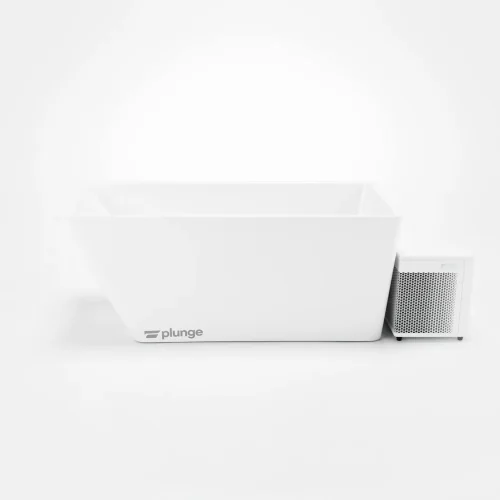
Why it stands out: The Plunge has earned its position as the category leader by hitting the right balance across every key metric: precise chilling to 39°F, a built-in filtration system that handles 2+ weeks between changes, an attractive spa-like aesthetic, and a 220V setup that's manageable for most homeowners. The Pro version adds a built-in heater (allowing heat therapy up to 103°F in the same unit) and better insulation for climate-controlled garages or outdoor use in cold regions.
What we like:
- Cools to 39°F with ±1°F precision via digital controls on the unit and app
- Integrated UV + ozone filtration reduces water changes to every 2–4 weeks
- Dual-mode Pro version supports cold and heat therapy in one unit
- 87-gallon capacity with a full-recline interior fits users up to 6'5"
- Beautiful high-density polyethylene shell holds up to UV and temperature cycling
What could be better:
- 220V requirement means professional electrical installation for most homes ($150–400 one-time cost)
- At 420 lbs filled, indoor placement requires careful floor load assessment
- No built-in seat or interior lighting at this price point
Best for: Serious cold therapy practitioners who want a reliable, year-round, set-it-and-forget-it experience at home. The Plunge Pro runs approximately $4,990. Available on the Plunge website and Amazon.
2. Ice Barrel 500 — Best for Budget-Conscious Beginners
Why it stands out: The Ice Barrel 500 is the most popular entry-level cold plunge on the market, and for good reason. It strips the concept down to essentials: a vertical insulated barrel that fits one person in a seated-immersion position, designed to be filled with ice and water rather than powered by a chiller. The vertical posture means you need substantially less water (approximately 110 gallons) and ice than a horizontal tub — reducing the ice cost per session meaningfully.
What we like:
- Under $1,200 price point is the lowest for a purpose-built cold plunge unit
- UV-stabilized polymer barrel is durable enough for permanent outdoor installation
- Vertical immersion requires less ice per session than horizontal alternatives
- Insulated lid retains cold and blocks sunlight, reducing melt time
- Includes a cover, step stool, and drainage spigot
What could be better:
- Requires ice or pre-chilled water — impractical in climates above 60°F without significant ice cost
- Vertical seated position is uncomfortable for users over 6'0" or with lower back issues
- No filtration — water must be fully changed every 3–5 days
- Summer operation in warm climates can cost $15–30/session in ice
Best for: Cold plunge beginners in cool climates, people with limited space (the barrel footprint is just 31" diameter), or those testing cold therapy before committing to a powered unit. Available on the Ice Barrel website and Amazon.
3. Renu Therapy Cold Stomp — Best Design and User Experience
Why it stands out: Renu Therapy builds cold plunge tubs that look like premium furniture. The Cold Stomp uses a proprietary dual-wall cedar construction with a high-density polyethylene liner, combining the thermal insulation and aesthetic warmth of natural wood with the practicality of a plastic interior. The built-in chiller runs on 110V (no electrician required) and cools water to 45°F, making it the best option for users who want a wood-aesthetic unit without compromising on temperature control.
What we like:
- Stunning cedar exterior blends into outdoor living spaces and decks
- 110V chiller eliminates need for a dedicated electrical circuit
- Reaches 45°F reliably in ambient temperatures up to 85°F
- Includes ozone water treatment system for 2–3 week water change intervals
- Compact footprint (58" x 30") works in smaller patios and decks
What could be better:
- Cedar exterior requires annual sealing to prevent cracking and UV damage in direct sun
- 110V chiller is slower to cool than 220V alternatives (6–8 hours to initial target temp)
- At approximately $3,800, it's priced between budget and premium without fully matching either category's performance
Best for: Homeowners who prioritize aesthetics and want a cold plunge that functions as a design feature on a deck or in a wellness room. Available on the Renu Therapy website.
4. Morozko Forge — Best for Performance and Precision
Why it stands out: Morozko Forge targets serious athletes and biohackers who want professional-grade equipment at home. The Forge is the only consumer cold plunge tub that can form actual ice in the water — the proprietary chilling system brings water to 33°F, allowing protocols that most home units simply cannot support. For elite athletes following very cold exposure protocols (the Rhonda Patrick approach recommends 40°F or below), the Forge is in a class of its own.
What we like:
- Industry-leading cooling to 33°F — the only consumer unit that creates ice-cold water
- Commercial-grade filtration (UV + ozone) supports 4+ weeks between water changes
- Stainless steel interior is hygienic, durable, and easy to sanitize
- App control with temperature scheduling and session logging
- Built-in seat, foot rest, and underwater LED lighting
What could be better:
- $5,500–$6,200 price range is the highest in the consumer market
- Requires 220V dedicated circuit with 20-amp breaker
- Large footprint (72" x 36") requires significant outdoor or indoor space
- Noise level from compressor is noticeable (comparable to a window AC unit)
Best for: Elite athletes, serious longevity practitioners, and performance-focused individuals for whom temperature precision and reliability justify the premium. Available on the Morozko website.
5. Polar Montecristo Platinum — Best Mid-Range Powered Option
Why it stands out: The Polar Montecristo Platinum sits at the sweet spot of the market — an actively chilled, well-filtered unit at a price point that undercuts The Plunge and Morozko while still delivering consistent temperature control and acceptable filtration. It uses a 110V chiller that reaches 50°F reliably, which covers the full physiologically active window for cold therapy without the electrical complexity of 220V units.
What we like:
- 110V operation — plugs into a standard household outlet, no electrician needed
- Reaches 50°F reliably in ambient temperatures up to 90°F
- Fibreglass shell with UV inhibitors holds up in outdoor installations
- Integrated filtration with chlorine tablet holder allows 2-week water change intervals
- Full-recline interior fits users up to 6'3"
What could be better:
- Cannot reach below 50°F, limiting protocols for very cold-adapted practitioners
- Fibreglass interior is less premium feeling than polyethylene or stainless alternatives
- App connectivity is limited — primarily temperature monitoring without scheduling
- At approximately $2,800, it's a meaningful jump over Ice Barrel without full parity with The Plunge
Best for: Users who want year-round temperature control without a 220V circuit and aren't chasing sub-50°F temperatures. Available on Polar and Amazon.
6. Lumi Recovery Pod — Best Portable and Space-Efficient Option
Why it stands out: The Lumi Recovery Pod is a collapsible cold plunge tub built for apartment dwellers, travelers, and anyone who can't install a permanent unit. It uses a heavy-duty PVC liner inside an insulated outer shell, sets up in under 10 minutes, and connects to an optional external chiller (sold separately at $499) or works with ice alone. The entire setup stores in a bag smaller than a golf travel case.
What we like:
- Fully portable — folds flat for storage in a closet or car trunk
- Works with or without the external chiller (ice-only option for beginners)
- 105-gallon capacity accommodates full shoulder submersion
- Drainage valve at the base — no pump required for emptying
- Under $400 for the tub alone; approximately $900 with the chiller
What could be better:
- PVC liner has a finite lifespan — expect replacement after 2–3 years of heavy use
- External chiller is underpowered in ambient temperatures above 80°F (reaches ~55°F minimum)
- No integrated filtration — water must be treated manually or changed every 3–5 days
- Less rigid structure makes it less comfortable for 15+ minute sessions than a hard-shell unit
Best for: Renters, apartment dwellers, frequent travelers, or anyone needing to store and deploy a cold plunge without permanent installation. Available on the Lumi website and Amazon.
Browse All Products
Explore our evidence-based product reviews across every health category.
The Science of Cold Water Immersion
Understanding the mechanisms behind cold therapy helps you use it more intelligently — and set realistic expectations about what it can and cannot do.
Norepinephrine: The Primary Driver of Cold Therapy Benefits
The most well-documented physiological response to cold water immersion is a dramatic surge in norepinephrine, a neurotransmitter and stress hormone that plays a central role in attention, focus, mood, and inflammation. A 2000 study in European Journal of Applied Physiology found that immersion in 57°F (14°C) water for 1 hour increased norepinephrine levels by 300–400% above baseline — and critically, this elevation persisted for several hours post-immersion.
Norepinephrine directly suppresses TNF-alpha and IL-6, two of the most potent pro-inflammatory cytokines in the body. This is the primary mechanism behind cold water immersion's well-documented effect on post-exercise soreness. A 2022 Cochrane review of 32 trials confirmed that cold water immersion significantly reduces DOMS (delayed onset muscle soreness) compared to passive rest, with optimal effects at 50–59°F.
The Wim Hof Research
Wim Hof's ability to consciously influence his immune response during cold exposure drew scientific attention to a practice many had dismissed as mere performance. A landmark 2014 study in PNAS trained a group of participants in Hof's method (cold exposure combined with breathing techniques) and found they could voluntarily reduce their innate immune response when injected with bacterial endotoxin — something previously thought impossible. Inflammatory markers including TNF-alpha were significantly lower in the trained group.
While Hof's methods include breathwork as well as cold exposure, the cold component appears to be a key variable. Follow-up research has isolated cold immersion from breathwork to confirm the anti-inflammatory effects persist independently.
Dopamine and Mood
A 2000 study in Biological Psychiatry documented that cold water immersion increases plasma dopamine levels by up to 250% above baseline — a magnitude that exceeds most recreational stimulants and lasts for 2–4 hours without the crash that follows caffeine or stimulant use. This explains why consistent cold plunge practitioners often report improved mood, motivation, and mental clarity — and why cold exposure is being investigated as an adjunctive treatment for depression.
Optimal Protocol: Temperature, Duration, and Frequency
Based on the current research literature, the optimal cold water immersion protocol for most people looks like this:
- Temperature: 50–59°F (10–15°C). Below 50°F is not meaningfully more beneficial for most users and increases discomfort and risk.
- Duration: 2–10 minutes per session. A 2021 study in Temperature found the greatest norepinephrine response occurs in the first 2–3 minutes. Sessions beyond 10 minutes offer diminishing returns for most protocols.
- Frequency: 3–5 sessions per week. Daily cold exposure may blunt the acute hormetic response over time for some individuals.
- Timing: Morning sessions appear best for focus and mood benefits. Post-exercise sessions (within 30 minutes) are best for recovery. Notably, a 2021 study in Nature Reviews Physiology found that immediate post-exercise cold immersion may blunt muscle protein synthesis — if strength or muscle hypertrophy is the primary goal, delaying cold immersion 4–6 hours after lifting is recommended.
For a broader look at how cold therapy fits into a recovery and longevity protocol, see our exercise and longevity guide.
Get smarter about health tech
Deal alerts, new reviews, and health tips — delivered weekly. No spam.
Unsubscribe anytime. We respect your inbox.
FAQ
What temperature should a cold plunge be?
The research-supported range is 50–59°F (10–15°C). This range reliably triggers the norepinephrine surge, anti-inflammatory response, and dopamine elevation associated with cold therapy benefits. Colder temperatures (below 50°F / 10°C) increase discomfort and risk without proportionally greater benefit for most users. Warmer temperatures (above 60°F / 15°C) begin to lose therapeutic efficacy. Most cold plunge units are calibrated around 55°F as a default starting point.
How long should I stay in a cold plunge?
Start with 2–3 minutes and build to 5–10 minutes over 2–4 weeks. The norepinephrine response peaks in the first 2–3 minutes of immersion, so even short sessions deliver meaningful benefits. Sessions beyond 10–12 minutes offer diminishing physiological returns and increase the risk of hypothermia for some users. Never force yourself past the point where your breathing becomes uncontrolled.
Is a cold plunge tub worth the investment?
For consistent practitioners using their unit 3–5 times per week, yes — a quality cold plunge tub replaces the need for ice (which costs $5–15 per session without a chiller), delivers a cleaner and more hygienic experience than stock tanks, and maintains therapeutic temperatures year-round. The break-even point versus buying ice runs approximately 8–14 months for mid-range units. For occasional users (once a week or less), a non-chilled barrel or local cold therapy studio may be more economical.
Can I use a cold plunge after a workout?
Yes, with an important nuance: if your goal is cardiovascular fitness, muscle recovery, or reducing soreness, cold immersion immediately post-exercise is beneficial. If your goal is building muscle mass or strength, delay your cold plunge by at least 4–6 hours after resistance training. A 2021 study in Nature Reviews Physiology found that immediate post-lifting cold immersion attenuates mTOR signaling and reduces satellite cell activity, potentially blunting muscle protein synthesis. This does not appear to affect cardiovascular adaptations from aerobic training.
Affiliate Disclosure: Better Vitals may earn a commission when you purchase through our links. Our recommendations are based on independent research and, where possible, hands-on testing. Your purchase supports our mission to deliver honest, science-backed health optimization content.
Featured Products
Products mentioned in this article
Related Guides
More articles you might find helpful
Best Bed Cooling Systems 2026: Eight Sleep vs Cheaper Alternatives
**Disclosure:** Product CTAs on this page currently go to manufacturer sites (no affiliate tracking yet). Better Vitals may earn a commission once partner links are live — rankings and "skip if" calls won't change when we swap URLs. We only recommend gear we'd put on a shortlist for a specific type
Is the Oura Membership Worth It in 2026? (And How to Skip It)
*Updated July 2026*
Oura Ring Price in 2026: Every Model, Subscription & Real Total Cost
*Updated July 2026*

Written by
Steve Luu
Health tech researcher