Best Diets for Longevity: Mediterranean, Blue Zones & What Actually Works
Key Takeaway
Everyone has a diet opinion. Your cousin swears by keto. Your coworker won't shut up about intermittent fasting. Some guy on a podcast told you that carnivore cured his autoimmune disease. And somewhere in the noise, a well-meaning influencer is selling you a $200 supplement stack as "the longevity
Affiliate Disclosure: BetterVitals may earn a commission from purchases made through links in this article, at no additional cost to you. This supports our independent research and analysis. We only recommend products we believe in after thorough evaluation.
Medical Disclaimer
This article is for educational purposes only and is not a substitute for professional medical advice, diagnosis, or treatment. Always consult your healthcare provider before making health decisions.
Best Diets for Longevity: Mediterranean, Blue Zones & What Actually Works
Everyone has a diet opinion. Your cousin swears by keto. Your coworker won't shut up about intermittent fasting. Some guy on a podcast told you that carnivore cured his autoimmune disease. And somewhere in the noise, a well-meaning influencer is selling you a $200 supplement stack as "the longevity protocol."
Here's the thing: most of these opinions are based on anecdotes, short-term studies, or outright marketing. When you zoom out and look at the actual population-level data — the stuff that tracks what people eat and how long they live across decades and continents — a much clearer picture emerges. And it's not nearly as sexy as the latest TikTok diet trend.
The evidence points to a handful of dietary patterns that consistently correlate with longer, healthier lives. Not perfectly. Not without caveats. But consistently enough that if you're serious about longevity, you should be paying attention.
Let's break down what the research actually says.
The Mediterranean Diet: The Most Studied Longevity Diet
If you could only follow one dietary pattern for the rest of your life, the Mediterranean diet has the strongest evidence behind it. Full stop. This isn't a trendy claim — it's backed by decades of epidemiological data and one of the most rigorous dietary intervention trials ever conducted.
The PREDIMED Trial
The landmark study here is PREDIMED (Prevención con Dieta Mediterránea), published in the New England Journal of Medicine in 2013 and republished with corrected methodology in 2018. This was a randomized controlled trial — the gold standard — involving 7,447 participants at high cardiovascular risk across Spain.
The results were striking: participants assigned to a Mediterranean diet supplemented with extra-virgin olive oil or mixed nuts had a 30% relative reduction in major cardiovascular events (heart attack, stroke, or cardiovascular death) compared to the control group. The trial was actually stopped early because the benefits were so clear that it was considered unethical to keep the control group on their existing diet.
Beyond PREDIMED, a 2018 meta-analysis in the British Medical Journal pooling data from 12.8 million participants found that higher adherence to a Mediterranean diet was associated with a 10% reduction in overall mortality, a 9% reduction in cardiovascular mortality, and a 6% reduction in cancer incidence.
Why does it work?
The Mediterranean diet isn't magic. It works because it naturally delivers:
- High polyphenol intake from olive oil, red wine, and vegetables — potent anti-inflammatory compounds
- Omega-3 fatty acids from fish, nuts, and seeds — critical for cardiovascular and brain health
- Abundant fiber from legumes, whole grains, and vegetables — feeding beneficial gut bacteria and improving glucose regulation
- Low processed food consumption — which reduces inflammation, insulin resistance, and oxidative stress
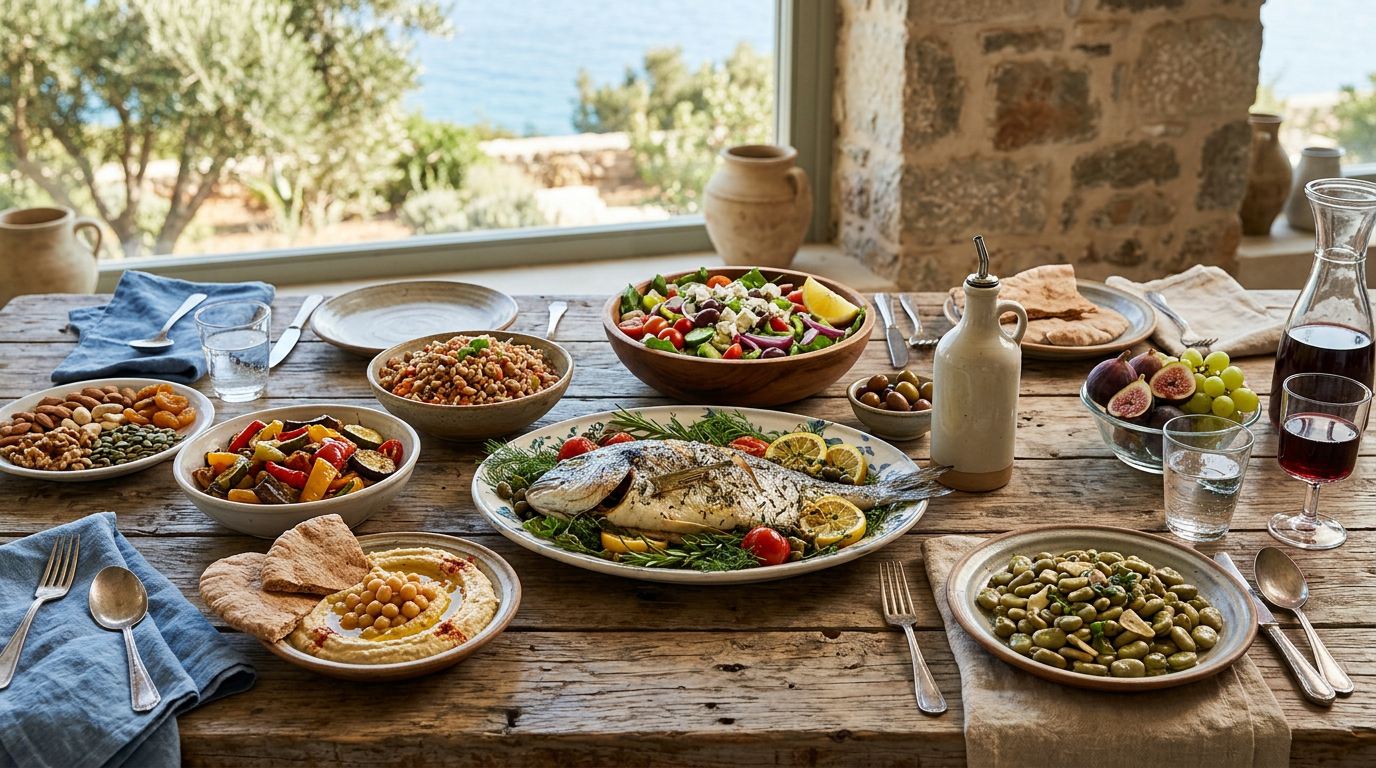
The Mediterranean diet isn't a list of rules. It's a pattern: lots of vegetables, legumes, whole grains, fish, olive oil, nuts, moderate wine, and very little processed food, red meat, or added sugar. The flexibility is part of why it's sustainable — and sustainability is what actually matters for longevity.
Blue Zones: What Centenarians Actually Eat
Dan Buettner's Blue Zones research identified five regions where people live disproportionately long: Okinawa (Japan), Sardinia (Italy), Nicoya (Costa Rica), Ikaria (Greece), and Loma Linda (California — specifically the Seventh-day Adventist community). His team studied the dietary and lifestyle patterns of centenarians in these regions, and the findings have become gospel in the longevity world.
The common dietary patterns across Blue Zones:
- 95% plant-based — meat is consumed sparingly, typically 5 times per month or less
- Legumes are the cornerstone — beans, lentils, chickpeas, and soy appear in nearly every Blue Zone
- Whole grains dominate — not refined flour, but actual intact grains
- Moderate caloric intake — Okinawans practice hara hachi bu (eating until 80% full)
- Minimal processed food — because most of these diets were established before ultra-processed food existed
But let's be honest about the limitations.
The Blue Zones data is observational. You can't randomly assign people to live in Sardinia for 80 years and see what happens. There are massive confounding variables: social cohesion, physical activity levels (these are people who walk everywhere), lower stress, strong community ties, purpose, and sometimes even data quality issues.
In fact, a 2024 analysis by Saul Newman published in PLOS ONE raised serious questions about the accuracy of age records in several Blue Zones, suggesting that some "centenarians" may not have been as old as claimed — particularly in regions with historically poor birth documentation. This doesn't invalidate the dietary patterns, but it does mean we should hold the Blue Zones data with appropriate skepticism rather than treating it as gospel.
What is valuable is that the Blue Zones research converges with the clinical trial data: the dietary patterns that show up in long-lived populations overlap heavily with what the Mediterranean diet delivers. Lots of plants, legumes, whole grains, healthy fats, minimal processed food. The signal is consistent even if the individual data points are imperfect.
Intermittent Fasting: Promising But Overhyped
Let's talk about fasting. Because if you spend five minutes in the longevity space, someone will tell you that time-restricted eating is the key to living forever. And the animal data is genuinely interesting — caloric restriction extends lifespan in yeast, worms, flies, and mice. That's real. But the leap from "mice live longer when you cut their calories by 30%" to "you should skip breakfast" is much larger than most people realize.
What the human data actually shows:
A 2022 study in the New England Journal of Medicine randomized 139 participants with obesity to either caloric restriction alone or caloric restriction combined with 16:8 time-restricted eating for 12 months. The result? No significant difference in weight loss, body fat, metabolic markers, or any other outcome. The time restriction added nothing beyond the caloric deficit.
A much larger observational study presented at the American Heart Association's 2024 Scientific Sessions, analyzing data from over 20,000 adults in the National Health and Nutrition Examination Survey (NHANES), found that participants who restricted eating to fewer than 8 hours per day had a 91% higher risk of cardiovascular death compared to those eating within a 12-16 hour window. Now, this was observational — the people restricting their eating may have had other risk factors — but it certainly pours cold water on the idea that aggressive fasting is universally protective.
The honest assessment:
- Caloric restriction has strong evidence for metabolic benefit in humans — reducing insulin, improving lipid profiles, lowering inflammation
- Time-restricted eating is mostly a tool that helps some people eat fewer calories. If it works for your schedule and you feel good doing it, fine. But there's no compelling evidence that the timing itself provides longevity benefits independent of total caloric intake
- Extended fasting (24-72 hours) triggers autophagy — cellular cleanup — in animal models, but human data on longevity outcomes is essentially nonexistent
- The risk is that fasting culture encourages disordered eating patterns, muscle loss in older adults, and a false sense of optimization
If you enjoy intermittent fasting and it helps you maintain a healthy weight, keep doing it. But don't mistake it for a longevity intervention with strong human evidence. It isn't — at least not yet.
Browse All Products
Explore our evidence-based product reviews across every health category.
The Common Thread: What All Longevity Diets Share
Here's what's interesting: if you strip away the branding and the tribalism, the dietary patterns associated with longevity converge on a remarkably consistent set of principles. Whether you call it Mediterranean, Blue Zone, DASH, or just "eating like a reasonable adult," the common threads are:
1. Whole, minimally processed foods
The single strongest predictor of diet quality across the longevity literature is the degree of food processing. A 2019 study in The BMJ following 44,551 French adults for seven years found that a 10% increase in ultra-processed food consumption was associated with a 14% higher risk of all-cause mortality. A 2024 meta-analysis in The BMJ including over 9.9 million participants reinforced this, finding dose-dependent associations between ultra-processed food intake and over 30 adverse health outcomes, including cardiovascular disease, type 2 diabetes, and cancer. This is the single most impactful dietary change most people can make.
2. High fiber intake (30+ grams per day)
Fiber feeds your gut microbiome, slows glucose absorption, lowers cholesterol, and reduces inflammation. A 2019 Lancet meta-analysis commissioned by the WHO found that people consuming 25-29 grams of fiber daily had a 15-30% reduction in all-cause mortality, cardiovascular disease, type 2 diabetes, and colorectal cancer compared to low-fiber eaters. Most Americans get about 15 grams. That gap matters.
3. Plant diversity
The American Gut Project found that people who consume 30+ different plant species per week have significantly more diverse gut microbiomes than those eating fewer than 10. Gut microbiome diversity is increasingly linked to immune function, metabolic health, and longevity. This doesn't mean you need to be vegetarian — it means you need to eat a wide variety of plants.
4. Omega-3 fatty acids
A 2021 study in The American Journal of Clinical Nutrition following 2,240 participants over 11 years found that those with the highest blood levels of omega-3 fatty acids (EPA and DHA) lived an average of 4.7 years longer than those with the lowest levels. The effect size was comparable to the difference between smoking and not smoking.
5. Low sugar and refined carbohydrates
Not zero carbs — that's unnecessary. But consistently elevated blood sugar and insulin drive chronic inflammation, glycation (protein damage), and accelerated aging. Managing your glucose variability is one of the most actionable things you can do for longevity.
The Role of Metabolic Monitoring
Here's where it gets practical. You can read about longevity diets all day, but the uncomfortable truth is that the same food affects different people differently. A bowl of oatmeal might barely move one person's blood sugar and send another into a full-blown glucose spike. Your genetics, gut microbiome, sleep quality, stress levels, and even the time of day all influence how you metabolize food.
This is where continuous glucose monitors (CGMs) become genuinely useful — not as a gimmick, but as a feedback tool. A CGM lets you see, in real time, how your actual dietary choices affect your metabolic health. Instead of guessing whether your "healthy" breakfast is actually healthy for you, you can measure it.
For a deeper dive on whether a CGM makes sense for you, check out our guide on CGMs for non-diabetics. If you're considering one, Levels Health pairs CGM data with software designed specifically for metabolic optimization, Nutrisense offers dietitian support alongside the data, and Dexcom Stelo is the most affordable over-the-counter option from the industry leader.
The point isn't to obsess over every glucose spike. It's to build self-knowledge: which foods, meal timings, and combinations work best for your body. Run a 2-4 week experiment, learn your patterns, then move on with that knowledge. That's the optimal use case.
What About Supplements?
No diet article would be complete without addressing the supplement question. The short answer: a well-constructed diet based on the principles above will cover most of your bases. But there are evidence-backed gaps worth filling.
A quality greens powder like AG1 can help bridge micronutrient gaps — especially if your vegetable intake is inconsistent (and be honest with yourself about that). And the emerging research on gut microbiome health makes a strong case for a well-formulated probiotic like Seed DS-01, particularly given the connection between gut diversity and the longevity-associated dietary patterns we've discussed.
We go much deeper on this in our guide to the best supplements for longevity, including which specific compounds have real evidence and which are just expensive urine.
Get smarter about health tech
Deal alerts, new reviews, and health tips — delivered weekly. No spam.
Unsubscribe anytime. We respect your inbox.
The Bottom Line
The best longevity diet isn't complicated. It isn't branded. It doesn't require a subscription, a meal plan, or a guru. The population-level data — from the Mediterranean basin to Okinawa to the clinical trial literature — points to the same basic pattern:
- Eat mostly whole, minimally processed foods
- Prioritize plants — especially legumes, vegetables, and whole grains
- Get enough fiber (aim for 30+ grams daily)
- Include omega-3-rich foods regularly (fatty fish, walnuts, flax)
- Use olive oil as your primary fat
- Minimize ultra-processed food, added sugar, and refined carbohydrates
- Don't overeat — but don't obsess over timing windows either
The gap between knowing this and doing it is where most people fail. Not because the information is hard to find, but because consistency is hard. The best diet for longevity is the one you'll actually follow for decades — not the one that sounds impressive at a dinner party.
Pick a pattern that aligns with your preferences and culture. Learn how your body responds to different foods — whether through a CGM, a food journal, or just paying attention. And then do it consistently, without perfection, for a very long time.
That's the real longevity protocol. Everything else is noise.
FAQ
Is the Mediterranean diet the best diet for longevity?
Based on the current evidence, yes — it has the strongest combination of randomized controlled trial data (PREDIMED) and long-term epidemiological support. The PREDIMED trial showed a 30% reduction in cardiovascular events, and multiple meta-analyses associate it with reduced overall mortality, cancer incidence, and neurodegenerative disease risk. That said, the core principles overlap with many other healthy dietary patterns. You don't need to eat Greek food specifically — you need to eat whole foods, plants, healthy fats, and minimal processed food.
Are Blue Zones diets actually proven to extend lifespan?
Blue Zones research provides valuable observational data, but it's important to understand the limitations. The data is correlational, not causal — longevity in these regions is influenced by social structure, physical activity, community, purpose, and genetics alongside diet. Recent scrutiny of age-record accuracy in some Blue Zones also raises questions about the underlying data. The dietary patterns identified (plant-heavy, legume-rich, moderate calories) are supported by independent clinical evidence, but the Blue Zones framework itself should be seen as suggestive, not definitive.
Does intermittent fasting extend lifespan in humans?
There is no convincing evidence that intermittent fasting extends human lifespan independent of caloric restriction. Animal models show lifespan extension with caloric restriction, but human trials of time-restricted eating (like 16:8 fasting) have not demonstrated benefits beyond those achieved through caloric deficit alone. A large NHANES analysis even found an association between aggressive time restriction (under 8 hours) and increased cardiovascular mortality, though this was observational. Fasting may be a useful weight management tool for some people, but calling it a proven longevity intervention overstates the evidence.
How much fiber should I eat daily for longevity?
The WHO-commissioned Lancet meta-analysis found the strongest benefits at 25-29 grams per day, with additional benefits up to about 30-35 grams. Most Americans consume roughly 15 grams — about half the minimum target. Focus on legumes (lentils, chickpeas, black beans), vegetables, whole grains, nuts, seeds, and berries. Increase gradually to avoid digestive discomfort, and make sure you're drinking enough water as you add fiber.
Can a CGM help me optimize my diet for longevity?
A CGM can be a genuinely useful short-term tool for understanding your individual metabolic responses to food. Different people respond differently to the same foods, and a CGM removes the guesswork by showing you real-time glucose data. This is particularly valuable for identifying hidden glucose spikes from foods you assumed were healthy. That said, most people don't need to wear one indefinitely — a 2-4 week learning period is typically enough to identify your personal patterns. Check out our CGM guide for non-diabetics for a detailed breakdown.
What's more important for longevity — what you eat or how much you eat?
Both matter, but the evidence suggests that what you eat has a larger impact than caloric quantity alone. The ultra-processed food data is particularly damning — you can be at a healthy weight and still face elevated mortality risk from a diet high in processed food. That said, chronic overeating drives obesity, insulin resistance, and inflammation, all of which accelerate aging. The practical answer: eat mostly whole foods, prioritize plants and fiber, and let your appetite — not a calorie tracker — guide quantity. If you're eating high-quality food, your hunger signals tend to self-regulate.
Featured Products
Products mentioned in this article




Related Guides
More articles you might find helpful
Best Bed Cooling Systems 2026: Eight Sleep vs Cheaper Alternatives
**Disclosure:** Product CTAs on this page currently go to manufacturer sites (no affiliate tracking yet). Better Vitals may earn a commission once partner links are live — rankings and "skip if" calls won't change when we swap URLs. We only recommend gear we'd put on a shortlist for a specific type
Is the Oura Membership Worth It in 2026? (And How to Skip It)
*Updated July 2026*
Oura Ring Price in 2026: Every Model, Subscription & Real Total Cost
*Updated July 2026*

Written by
Steve Luu
Health tech researcher