Best Bed Cooling Systems 2026: Eight Sleep vs Cheaper Alternatives
Key Takeaway
Disclosure: Product CTAs on this page currently go to manufacturer sites (no affiliate tracking yet). Better Vitals may earn a commission once partner links are live — rankings and "skip if" calls won't change when we swap URLs. We only recommend gear we'd put on a shortlist for a specific type
Affiliate Disclosure: BetterVitals may earn a commission from purchases made through links in this article, at no additional cost to you. This supports our independent research and analysis. We only recommend products we believe in after thorough evaluation.
Medical Disclaimer
This article is for educational purposes only and is not a substitute for professional medical advice, diagnosis, or treatment. Always consult your healthcare provider before making health decisions.
Disclosure: Product CTAs on this page currently go to manufacturer sites (no affiliate tracking yet). Better Vitals may earn a commission once partner links are live — rankings and "skip if" calls won't change when we swap URLs. We only recommend gear we'd put on a shortlist for a specific type of hot sleeper.
If you wake up sweaty, kick the covers at 2 a.m., or share a bed with someone who runs colder than you, active bed cooling is one of the few sleep upgrades that changes the night itself—not just the morning report.
This guide compares the main approaches in 2026: water-based smart covers (Eight Sleep Pod 5 / Pod 4), subscription-free hydronic pads (Sleepme / ChiliPad Dock-style systems), forced-air systems (BedJet), and mattress-integrated climate beds (Sleep Number ClimateCool / Climate360-class). It's a research, spec, and total-cost-of-ownership (TCO) synthesis—not a claim that we ran a multi-week lab bake-off for every SKU listed.
Quick take: Buy Eight Sleep if you want automated dual-zone climate plus built-in tracking and you're okay paying for Autopilot. Buy a Dock-style hydronic system if you want strong surface cooling without a mandatory subscription. Buy BedJet if you need speed, moisture wicking, and a lower entry price. Skip everything fancy if you only run warm a few nights a month—start with bedding and room HVAC first.
Take the Hot Sleeper Score quiz →
Get a custom cooling plan and gear shortlist in about two minutes.
Quick verdict
| Award | Pick | Why it wins | Rough starting point* | Skip if… |
|---|---|---|---|---|
| Best overall | Eight Sleep Pod 5 (Core / Plus / Ultra tiers) | Strongest "set it and forget it" dual-zone climate + wearable-free tracking ecosystem | Hardware often ~$2,800–$5,000+ depending on tier/size; Autopilot required for full smart features | You refuse recurring software fees |
| Best no-subscription | Sleepme / ChiliPad Dock-style (e.g. Dock Pro WE dual-zone) | Real hydronic cooling/heating without locking core temps behind a membership | Dual-zone often ~$1,500–$2,000; single-zone lower | You want Eight-style Autopilot AI + deep biometrics in one box |
| Best budget | BedJet 3 | Lowest meaningful "active cooling" entry; fast air + sweat drying | Single-zone often ~$500–$700; dual-zone kits higher | You need deep sub-ambient surface cold in a hot room |
| Best for couples | Eight Sleep Pod 5 or Dock Pro dual-zone | Independent left/right setpoints; Eight adds smarter automation, Dock wins on TCO | See 5-year table below | One partner hates any hose, hub, or cover feel |
*Street prices and promos move constantly. Treat these as planning ranges, then verify live pricing before you buy. Links: Eight Sleep · Sleepme · BedJet · Sleep Number
Also worth knowing: Pod 4 is still a relevant "same platform, prior cover" path for some buyers. If you're hunting value inside the Eight ecosystem, compare Pod 4 vs Pod 5 hardware carefully—Autopilot is still the long-term cost driver. See our Eight Sleep Pod 5 review (Pod 4 Ultra remains a prior-gen value path — Pod 4 product).
How we evaluated
We assessed each system across five lenses:
- Cooling power & method — Water-based (hydronic), forced-air, or integrated mattress. Sub-ambient capability matters for hot rooms without AC.
- Noise & bedroom fit — Hub/pump volume, hose routing, partner tolerance.
- Dual-zone support — Can each side run independent temps?
- Subscription TCO over 5 years — Upfront hardware plus recurring software fees.
- Trial/warranty/exit risk — Return windows, warranty terms, and what happens if you stop paying for software.
Who this guide is for: People who wake up hot multiple nights per week, couples with mismatched temperature preferences, or anyone living in warm climates without reliable bedroom AC. This is active climate control—not passive bedding changes.
Who should skip this guide entirely:
- You only run warm a handful of nights per month (try a cooling mattress protector, lighter bedding, or a ceiling fan first—it's 1/10th the cost).
- You suspect you have a clinical sleep disorder like sleep apnea (see a sleep specialist for a proper study—bed cooling won't fix airway obstruction).
- You're unwilling to tolerate a bedside hub, hoses, or any equipment noise.
If you just want sleep tracking without temperature control, see our best sleep trackers guide.
Detailed picks
1. Eight Sleep Pod 5 — Best overall (if subscription OK)
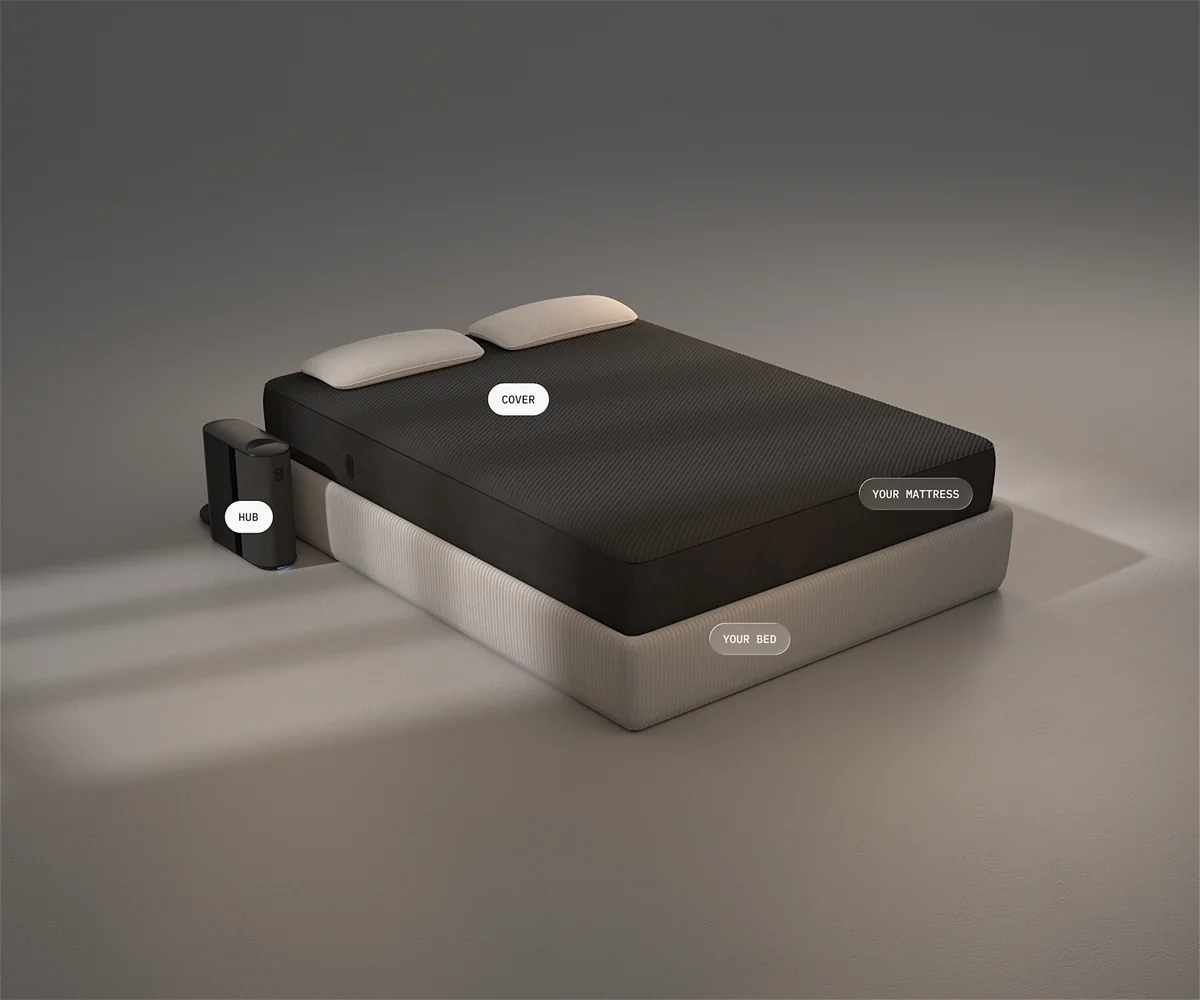
What it is: A smart mattress cover + Hub that circulates temperature-controlled water, with dual-zone control on typical couple setups, wearable-free sleep metrics, and Autopilot-driven automation. Pod 5 is sold in tiers (commonly framed as Core / Plus / Ultra)—cover+hub at the base, then climate blanket and smart base add-ons higher up.
Pod 4 note: Pod 4 remains a credible prior-generation cover on the same Autopilot platform. In many buyer guides, the jump from Pod 4 → Pod 5 is less "does cooling exist?" and more "tier packaging, accessories, sensor/thermal refinements." If you're price-sensitive inside Eight, Pod 4 hardware can be the better entry—but plan for Autopilot either way. Deeper dive: Eight Sleep vs ChiliPad · Pod 5 review · prior-gen: Pod 4 product.
Pros (category-level):
- Dual-zone hydronic climate with a mature automation story
- Sleep tracking without another wearable on your finger/wrist
- Ecosystem depth (blanket/base tiers) if you want one brand stack
- Strong fit for severe hot sleepers who want the bed to adjust overnight
Cons:
- Mandatory Autopilot for the features most people are buying (automation, full tracking experience)—this dominates 5-year cost
- Higher hardware sticker than Dock/BedJet
- Hub footprint + cover feel aren't for everyone
- Trial/warranty terms are less forgiving than some mattress brands; confirm current Autopilot-tied warranty extensions before you buy
Who it's for: Hot sleepers (and couples) who want the most complete "climate + data + automation" package and will keep paying for software.
Who should skip: Anyone optimizing for lowest TCO, rental apartments with strict setup limits, or buyers who already hate app-gated hardware.
CTA: Check current Eight Sleep pricing →
2. Sleepme / ChiliPad Dock-style — Best no-subscription hydronic
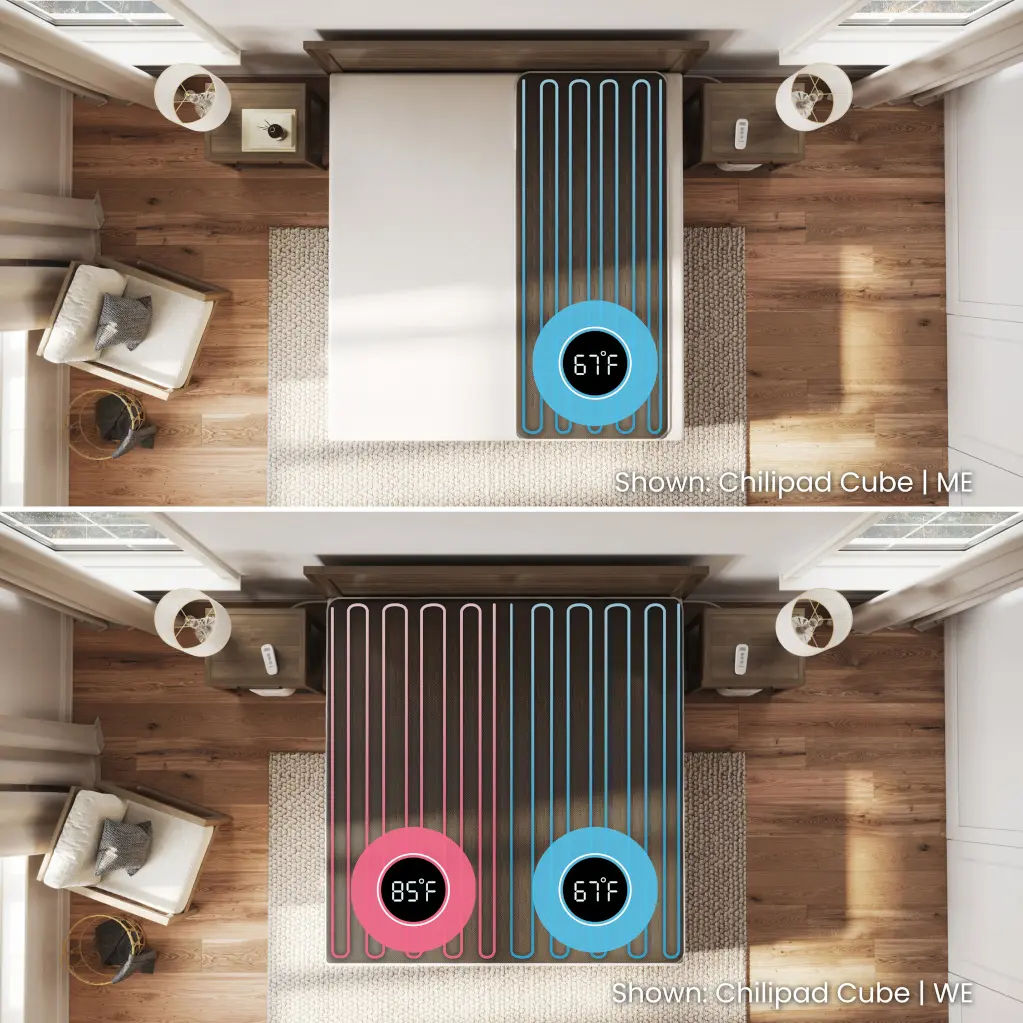
Sleepme (formerly ChiliSleep) makes water-based cooling pads that sit on top of your mattress. The Dock Pro is the current flagship—app-controlled, dual-zone capable (WE models), and no mandatory subscription for core temperature features.
How it works: A bedside control unit (the "Dock") pumps water through a thin pad. You set your target temp in the app or via the included remote. Dual-zone systems have two separate control units—one per side—each with independent scheduling.
Temperature range: 55-115°F. Slightly warmer max than Eight Sleep, though both exceed any realistic sleep need. Cooling power is strong—genuine sub-ambient surface temps even in warm rooms.
No sleep tracking. The Dock Pro cools and heats. That's it. If you want biometrics, you'll need a separate wearable like an Oura Ring or Whoop.
Pros:
- True hydronic cooling without subscription lock-in
- Dual-zone TCO is significantly lower than Eight Sleep over 5 years (no recurring fees)
- Strong cooling power—matches Eight Sleep's hydronic capability
- App control with scheduling (no AI, but you can program night routines)
- Warranty doesn't depend on software payments
Cons:
- No Autopilot-style AI or automatic adjustments
- No built-in sleep tracking or biometrics
- Pump noise is noticeable (comparable to or slightly louder than Eight Sleep's Hub)
- Water maintenance required (drain/refill quarterly, hydrogen peroxide cleaning)
- Less refined industrial design—functional but not Apple-sleek
Skip if: You want Eight-style Autopilot automation, built-in sleep tracking, or a true "set it and forget it" experience without manual scheduling.
Where to buy: Sleepme (direct, 60-night trial)
Related: ChiliPad Cube product page and Eight Sleep vs ChiliPad comparison
3. BedJet 3 — Best budget / air-based
BedJet takes a completely different approach: instead of water, it blows conditioned air under your sheets via a bedside unit. The air travels through the Cloud Sheet (sold separately), which has internal channels to distribute airflow across the bed.
Temperature range: Cool air or warm air (not sub-ambient cold like hydronic systems, but perceptibly cooler than room temp). Heating goes up to ~104°F. The big advantage is speed—BedJet adjusts temp in seconds, not minutes.
Moisture management: Forced air actively wicks sweat away from your body. If you're a heavy night sweater (not just warm), BedJet handles this better than water-based systems, which only address surface temperature.
Dual-zone: Requires two separate BedJet units (one per side) plus a dual-zone Cloud Sheet. Total cost for a full dual setup is higher than a single-zone BedJet but still cheaper than hydronic dual-zone systems.
Pros:
- Lowest entry price (~$500-700 for single-zone base kit)
- Fastest response time—temp changes feel immediate
- Excellent for sweat management (air dries moisture actively)
- No subscription fees
- Simpler maintenance than water systems (no refills, no water chemistry)
Cons:
- Less powerful sub-ambient cooling than hydronic systems in hot rooms
- Hose under the sheets can feel bulky (some people adapt, others hate it)
- Noise—the air blower is louder than hydronic pumps (think: small fan on low)
- Cloud Sheet feel is divisive (some love it, some find it crunchy or uncomfortable)
- No sleep tracking
Skip if: You need deep, sub-ambient cooling in a very hot room (hydronic wins here), or you're highly sensitive to hose/sheet feel.
Where to buy: BedJet (direct, 60-night trial)
4. Sleep Number ClimateCool / Climate360-class — Best if buying a mattress anyway
Sleep Number's climate beds integrate temperature control directly into the mattress—no separate topper or cover. The Climate360 smart bed combines air-chamber firmness adjustment, dual-zone temperature, and sleep tracking in one purchase.
How it works: Built-in fans and air chambers regulate temperature on each side. You adjust both firmness and temperature through the SleepIQ app. It's a complete sleep system—mattress, base, climate control, and tracking all bundled.
Pros:
- One integrated purchase for couples (no separate gear)
- Dual-zone temperature + dual-zone firmness in the same bed
- Sleep tracking included (SleepIQ sensors)
- No subscription for basic temperature and firmness control
- Clean aesthetics—no external hubs or hoses visible
Cons:
- Highest total upfront cost (~$4,500-6,000+ for a Queen/King climate bed)
- Requires buying a Sleep Number mattress (not modular—you can't add it to your existing bed)
- Less aggressive cooling than hydronic systems
- Proprietary ecosystem (you're locked into Sleep Number service/parts)
- If the system fails, you're replacing an entire mattress, not just a topper
Skip if: You're happy with your current mattress, you want the strongest possible cooling power, or you prefer modular systems you can upgrade independently.
Where to buy: Sleep Number (retail stores + direct, trial terms vary by location)
Browse All Products
Explore our evidence-based product reviews across every health category.
5-year cost comparison (illustrative planning ranges)
Subscription fees matter. Here's what the total cost of ownership looks like over 5 years:
| System | Hardware | Software (5 yrs) | Illustrative 5-yr total |
|---|---|---|---|
| Eight Sleep Pod 5 Core-class | ~$2,800–$3,200 | ~$1,000–$2,000 (Autopilot) | ~$3,800–$5,200 |
| Eight Sleep Pod 4 path | ~$2,400–$2,700 | ~$1,000–$2,000 (Autopilot) | ~$3,400–$4,700 |
| Sleepme Dock Pro dual-zone | ~$1,600–$2,000 | $0 required | ~$1,600–$2,000 |
| BedJet 3 dual-zone kit | ~$1,000–$1,600 | $0 | ~$1,000–$1,600 |
| Sleep Number Climate bed | ~$4,500–$6,000+ | $0 (usually) | ~$4,500–$6,000+ |
Key takeaway: Eight Sleep delivers the most sophisticated automation and tracking, but you're paying nearly double a Dock Pro's TCO over 5 years. BedJet is the budget entry point. Sleep Number makes sense if you're replacing a mattress anyway and want everything bundled.
Final verdict
For severe hot sleepers who value automation and tracking: Eight Sleep Pod 5. It's expensive, but Autopilot actually works—it learns your patterns and optimizes temps without manual input. The subscription feels like paying rent on your own hardware, but if you use the sleep data, $17/month is cheaper than a standalone wearable subscription.
For the best hydronic value without ongoing fees: Sleepme Dock Pro or ChiliPad Dock dual-zone. You get real sub-ambient cooling and heating, no subscription lock-in, and a 5-year TCO that's nearly half of Eight Sleep's. You lose Autopilot AI and sleep tracking, but if you already have an Oura Ring or don't care about biometrics, this is the smarter financial call.
For a low-cost test of active cooling: BedJet 3. Single-zone kits start around $500-700. It's the cheapest way to answer "does active bed cooling actually help me?" without committing $2,000+. If it works, you've solved the problem. If it doesn't, you're out less money.
For couples buying a new mattress who want everything integrated: Sleep Number Climate360-class bed. One purchase, one warranty, one app. You lose modularity and pay a premium, but it's the cleanest aesthetic solution for people who want no visible hubs or hoses.
Take the Hot Sleeper Score quiz →
Not sure which system fits your specific sleep situation? Our quiz asks about your temperature patterns, bedroom setup, and budget to recommend a shortlist.
Get smarter about health tech
Deal alerts, new reviews, and health tips — delivered weekly. No spam.
Unsubscribe anytime. We respect your inbox.
FAQ
What's the difference between water-based and air-based cooling?
Water-based (hydronic) systems like Eight Sleep and ChiliPad circulate water through a pad or cover. They deliver stronger sub-ambient cooling—genuine cold surface temps even when your bedroom is 75-80°F. Air-based systems like BedJet blow conditioned air under your sheets. They're faster to adjust and better at wicking moisture (sweat), but can't achieve the same level of deep cold as hydronic systems. If you need maximum cooling power, go hydronic. If you want speed and sweat management, go air.
Is the Eight Sleep Autopilot subscription worth it?
If you actually use the sleep tracking data and want automated temperature adjustments, yes. Autopilot learns your patterns over 2-3 weeks and runs invisibly—no manual scheduling. You also get HRV trends, sleep stage analysis, and morning insights. If you already have an Oura Ring or Whoop and just want temperature control, the subscription feels like paying rent on hardware you own. In that case, a Dock Pro or BedJet makes more sense.
Eight Sleep Pod 5 vs Pod 4—which should I buy?
Buy Pod 5 if you want the current tier/accessory stack. Consider Pod 4 if you find better hardware pricing and are fine living on the same Autopilot platform. Cooling capability exists on both; don't upgrade generations only for marketing. See Pod 5 review.
Do these systems work for couples with different temperature preferences?
Yes—that's the killer feature of dual-zone systems. Eight Sleep Pod 5, Sleepme Dock Pro WE, and dual-BedJet setups all let each side of the bed run independent temps. One partner can sleep at 65°F while the other sleeps at 78°F. No thermostat wars, no blanket hogging. Sleep Number Climate beds also support dual-zone control.
Will bed cooling fix my sleep apnea or insomnia?
No. Active bed cooling helps if your sleep problem is temperature-related (waking up hot, kicking covers, sweating). It won't fix obstructive sleep apnea, restless leg syndrome, or chronic insomnia caused by stress/anxiety. If you snore heavily, gasp for air at night, or have persistent sleep issues beyond temperature, see a sleep specialist for a proper evaluation. Don't self-diagnose with consumer tech.
I'm not sure if I actually need this. What should I try first?
If you only run warm occasionally, start with cheaper interventions before spending $1,000+:
- Lower your bedroom thermostat to 65-68°F (research shows this range optimizes sleep).
- Try a cooling mattress protector or moisture-wicking sheets (~$50-150).
- Use a ceiling fan or box fan for airflow.
- Check your bedding—heavy comforters trap heat. Switch to lighter blankets or ditch the top sheet.
If you've tried all that and still wake up hot multiple nights per week, active bed cooling makes sense. Take the Hot Sleeper Score quiz to get a custom recommendation based on your specific situation.
Related
- Eight Sleep vs ChiliPad: detailed head-to-head comparison
- Eight Sleep Pod 5 review 2026
- Eight Sleep Pod 4 product page
- ChiliPad Cube product page
- Best Sleep Trackers: if you want tracking without cooling
- Hot Sleeper Score quiz: get a custom gear shortlist
Last updated: September 2026
Featured Products
Products mentioned in this article
Related Guides
More articles you might find helpful
Is the Oura Membership Worth It in 2026? (And How to Skip It)
*Updated July 2026*
Oura Ring Price in 2026: Every Model, Subscription & Real Total Cost
*Updated July 2026*
Best CGM for Type 2 Diabetes Without Insulin (2026): OTC Options Compared
*Updated July 2026*

Written by
Steve Luu
Health tech researcher