Katalyst EMS Suit Review 2026: 4 Weeks with a $3,000 Training Suit
Key Takeaway
I bought a Katalyst EMS suit four weeks ago with my own money. Nobody sent me this for free, nobody asked me to write this review, and I have no relationship with the company. I want to get that out of the way immediately because a $3,000 fitness product deserves an honest take, not a glorified pres
Affiliate Disclosure: BetterVitals may earn a commission from purchases made through links in this article, at no additional cost to you. This supports our independent research and analysis. We only recommend products we believe in after thorough evaluation.
Medical Disclaimer
This article is for educational purposes only and is not a substitute for professional medical advice, diagnosis, or treatment. Always consult your healthcare provider before making health decisions.
Katalyst EMS Suit Review 2026: 4 Weeks with a $3,000 Training Suit
I bought a Katalyst EMS suit four weeks ago with my own money. Nobody sent me this for free, nobody asked me to write this review, and I have no relationship with the company. I want to get that out of the way immediately because a $3,000 fitness product deserves an honest take, not a glorified press release.
Here's why I pulled the trigger: I've been lifting consistently for years, but my schedule compressed significantly in early 2026. I went from comfortable 75-minute gym sessions four days a week to scrambling for 30-minute windows between calls. I'd been following whole-body electrical muscle stimulation (WB-EMS) research for a while and kept circling back to Katalyst as the most polished consumer option. When a friend let me try his suit for a single session, I was genuinely surprised by the intensity. Two days later, I ordered one.
Over the past four weeks, I've completed 10-12 sessions. That's enough to form real opinions about the hardware, the app, and the day-to-day experience — but I want to be upfront that it's not enough for definitive claims about body composition or long-term durability. Consider this an early-impressions review. I'll update it at 3 months and 6 months with harder data.
This article contains affiliate links. If you purchase through our links, BetterVitals may earn a commission at no extra cost to you. This does not influence our ratings or editorial opinions. See our full affiliate disclosure for details.
Medical disclaimer: EMS training is contraindicated for individuals with pacemakers, epilepsy, pregnancy, or certain other medical conditions. Consult your physician before starting any EMS training program.
What Is the Katalyst EMS Suit?
If you're unfamiliar with EMS training, here's the short version: electrical muscle stimulation uses low-frequency electrical impulses to trigger involuntary muscle contractions. When you layer those contractions on top of voluntary exercise — squats, lunges, planks — you recruit significantly more muscle fibers than you would with bodyweight alone. The concept has been used in physical therapy for decades, but whole-body EMS suits bring it into the consumer fitness space.
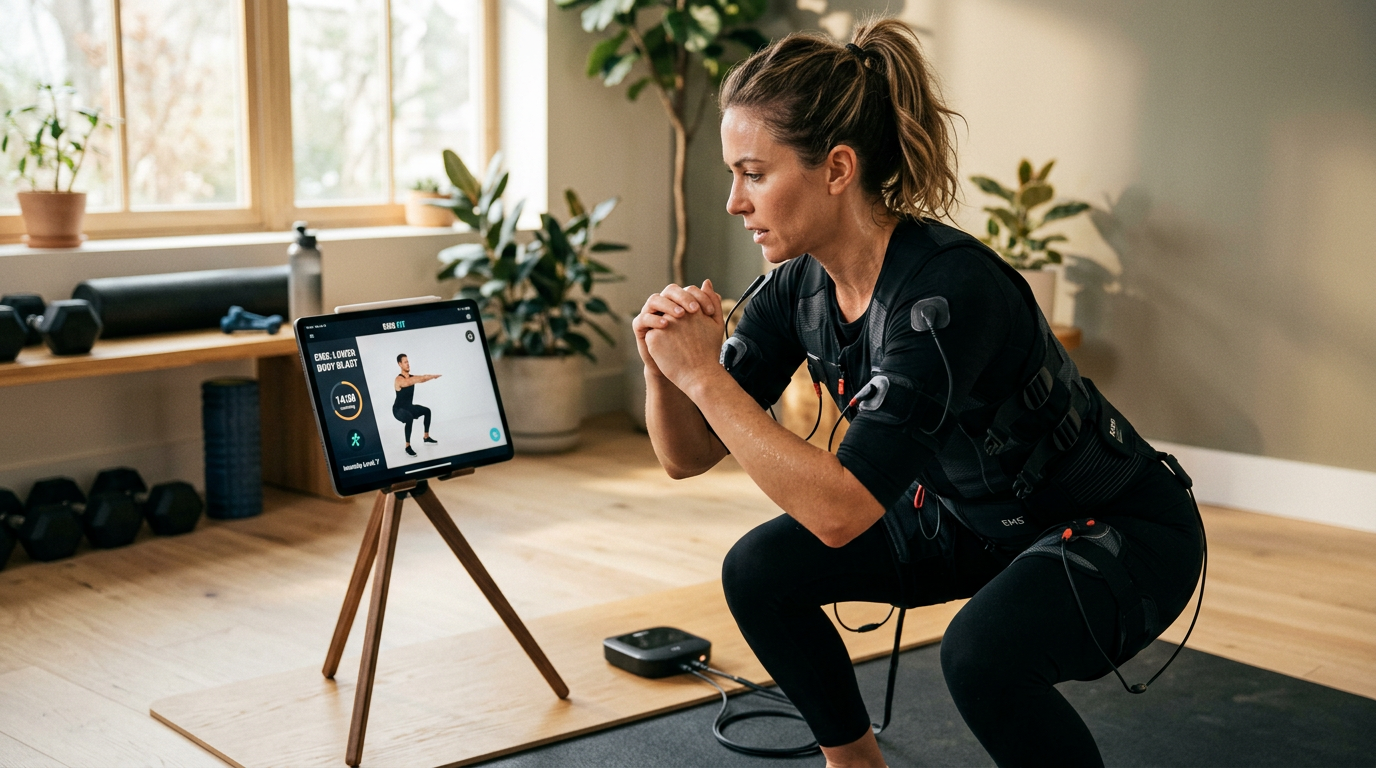
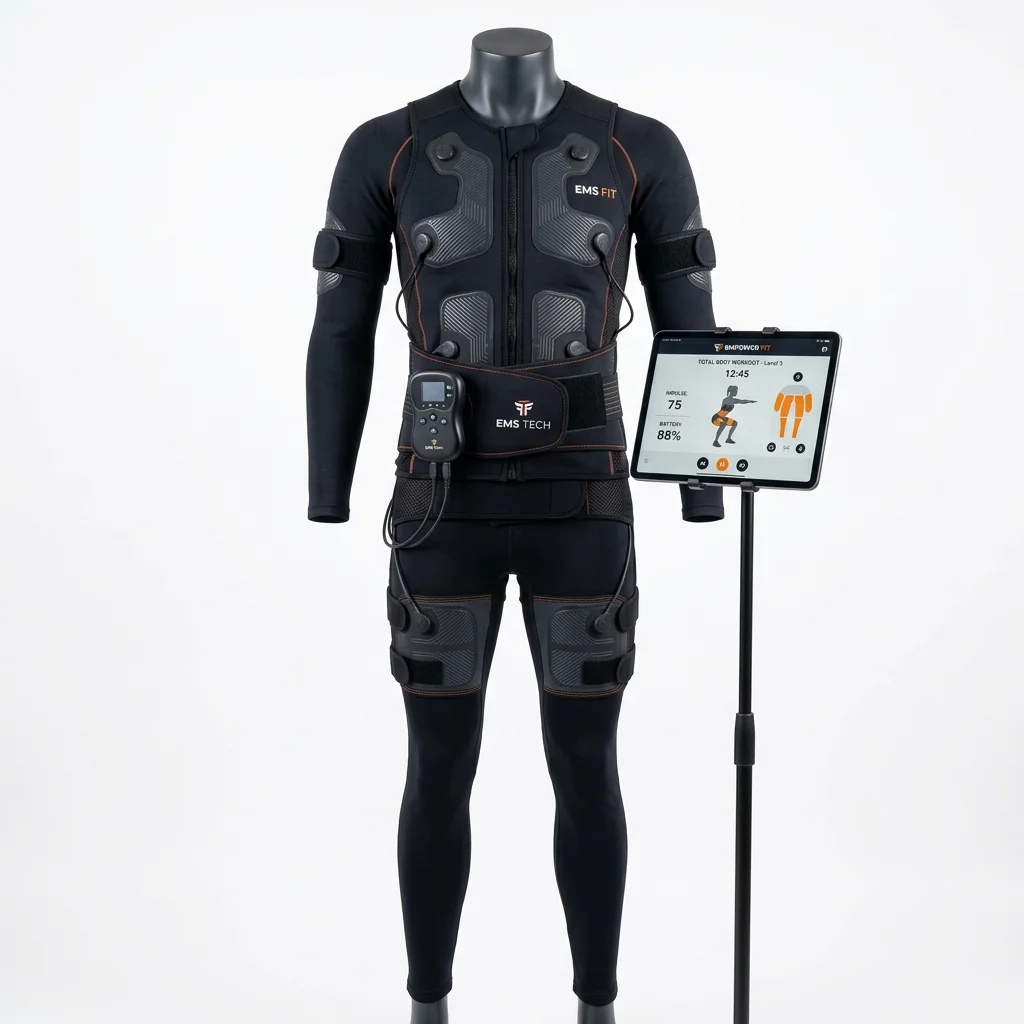
Katalyst's Gen 4 suit is the current model. It uses 26 wet electrode pads positioned across major muscle groups: chest, back, abs, glutes, quads, hamstrings, biceps, and triceps. A wireless impulse body unit clips onto the suit and communicates via Bluetooth with an iPad app that guides you through 20-minute workouts.
The suit is FDA-cleared as a Class II medical device for muscle conditioning, strengthening, and toning. That clearance doesn't mean it's a miracle device — it means it met the FDA's safety and efficacy standards for its stated claims.
Twenty minutes sounds almost too short to be meaningful. I was skeptical too. I'm not skeptical anymore.
Unboxing and First Impressions
Katalyst clearly understands that when someone spends $3,000 on a fitness product, the unboxing experience matters. The suit arrives in a premium carrying case — a structured, zippered bag that you'll actually keep using for storage and travel. It doesn't feel like an afterthought.
Inside the box, you get:
- The suit — a two-piece set (top and bottom) made of thick neoprene with integrated electrode pads
- The impulse body unit — a small wireless module that clips onto the suit's chest area
- A spray bottle — for wetting the electrode pads before each session
- A charger — USB-C for the impulse unit
- Quick-start guide and sizing info
First thing I noticed picking up the suit: it's heavier than I expected. The neoprene is substantial, and the embedded electrode pads add weight. It feels like a quality product — the stitching is clean, the zippers are solid, and the electrode pads are firmly integrated rather than glued on as an afterthought.
Bluetooth pairing with my iPad was straightforward. The app walked me through initial setup, fit verification, and a calibration session where you adjust intensity levels for each muscle group individually. The whole initial setup — from opening the box to completing my first calibration — took about 25 minutes.
One note on the iPad requirement: Katalyst only works with iPads. No iPhone, no Android, no web app. If you don't own an iPad, that's an additional $350-450 expense on top of the suit itself. I already had one, but I know this is a dealbreaker for some people, and it's a frustrating limitation in 2026.
The Setup Routine (Wet Prep Reality)
Every review of the Katalyst suit needs to be honest about this part, because it's the single biggest friction point in the daily experience.
Before every session, you need to spray each of the 26 electrode pads with water using the included spray bottle. The pads need to be damp — not dripping, but thoroughly moist — for proper electrical conductivity. Dry pads mean uneven stimulation and uncomfortable hot spots.
Here's what my pre-workout routine looks like:
- Lay out the suit (top and bottom)
- Spray each electrode pad — I do about 3-4 sprays per pad
- Put on the bottom piece (leggings-style, snug fit)
- Put on the top piece (vest-style with arm coverage)
- Clip in the impulse body unit
- Open the iPad app, connect via Bluetooth
- Select a workout
Total time from start to "pressing play" on a workout: 5-7 minutes once I got the routine down. The first few times it was closer to 10 minutes because I was figuring out the fit and spray technique.
Post-session cleanup adds another 3-4 minutes. You need to hang the suit to air dry — I use a wide hanger in my laundry room. A quick wipe-down of the electrode pads with a damp cloth keeps things fresh. Katalyst recommends a deeper clean every 8-10 sessions.
I'll be blunt: the wet prep is annoying. It's not complicated, but it adds a layer of friction that a gym workout doesn't have. When I'm short on time and debating whether to do a session, the 5-7 minutes of prep on top of the 20-minute workout sometimes tips the scale toward "I'll do it tomorrow." I've heard rumors that Katalyst is working on dry electrode technology for a future generation. That would be a game-changer.
That said, the total time investment — including prep and cleanup — is still only about 30 minutes. Compare that to my old routine of driving to the gym, warming up, doing a 60-minute session, showering, and driving home. Even with the wet prep, Katalyst saves me meaningful time.
The Workout Experience
The First Session
My first real workout (after the initial calibration) was humbling. I chose a "Full Body Strength" session and set my intensity levels conservatively — around 40-50% for most muscle groups based on the calibration.
When the first impulse hit, I involuntarily laughed. It's a genuinely strange sensation. Your muscles contract — hard — without your brain initiating the movement. Then the app tells you to do a squat while the stimulation is active, so you're performing a voluntary squat while your muscles are already under involuntary contraction. The result is an intensity of effort that feels disproportionate to what you're actually doing.
I was sweating within five minutes. By minute 12, my legs were shaking during lunges. By minute 18, I was genuinely counting down the seconds. And this was at 40-50% intensity.
The DOMS (delayed onset muscle soreness) after my first two sessions was significant. Not injury-level pain, but a deep, full-body soreness that lasted about 48 hours. My abs, in particular, were sore in places I hadn't felt in years. It reminded me of my first week of lifting as a teenager.
Settling Into a Rhythm
By session four or five, I had calibrated my intensity levels more precisely. Some muscle groups — my quads, for instance — can handle higher intensity than others. My lower back is more sensitive, so I keep that dialed down. The app lets you adjust individual muscle groups in real time during the workout, which is essential for finding your sweet spot.
The guided coaching is solid. The app displays exercise demonstrations and counts reps for you. The trainer cues are clear: "squat down... hold... and up." The movements themselves are basic — squats, lunges, planks, bicep curls, lateral raises, deadlift positions — but the EMS overlay makes simple movements remarkably challenging.
By week two, sessions felt productive rather than overwhelming. I could push my intensity to 55-65% on most muscle groups and complete sessions feeling genuinely fatigued but not destroyed.
Session Types
Katalyst offers several workout categories:
- Strength — higher intensity impulses, slower movements, longer holds
- Cardio — faster-paced movements with rhythmic stimulation patterns
- Recovery — gentle impulses, stretching-focused, lower intensity
I've mostly stuck with strength sessions (8 of my ~12 sessions) with a couple of cardio and one recovery session mixed in. The strength workouts are where I feel the most value. The cardio sessions are fine, but they don't replace actual cardiovascular training — my heart rate peaks around 130-140 BPM during Katalyst cardio, whereas a real running or cycling session puts me at 160+.
The 20-Minute Format
Here's the thing that surprised me most: 20 minutes is genuinely enough. I walked in expecting to feel short-changed. Instead, I finish sessions legitimately fatigued. The constant muscle stimulation means there's no downtime — every second of those 20 minutes involves muscular work. Compare that to a traditional gym session where rest periods, transitions between exercises, and phone-checking probably eat up 30-40% of your total time.
Browse All Products
Explore our evidence-based product reviews across every health category.
My Results After 4 Weeks (Early Impressions)
I want to be responsible here. Four weeks and 10-12 sessions is not enough time to make definitive claims about body composition changes, strength gains, or long-term efficacy. Anyone telling you they transformed their body with EMS in a month is selling something. Here's what I can honestly report:
Subjective improvements:
- Core engagement — This is the most noticeable change. My core feels more "connected" during daily movements and during my regular gym sessions. The deep abdominal stimulation seems to have improved my mind-muscle connection in a way I wasn't expecting.
- Posterior chain activation — My glutes and hamstrings feel noticeably more engaged, both during Katalyst sessions and during regular deadlifts and squats at the gym. This is probably my favorite early result.
- General muscle tone — My wife mentioned my arms looked "different" without me prompting the conversation. Take that for whatever it's worth — it's a sample size of one very biased observer.
What I can't claim yet:
- Body composition changes — I haven't done a DEXA scan. I'm planning one at the 3-month mark so I have real data instead of mirror assessments. I'll update this review with those numbers.
- Strength improvements — I haven't done standardized strength testing. I'm planning a simple benchmark (squat, deadlift, bench, pull-ups) at 12 weeks to compare against my pre-Katalyst numbers.
- Long-term consistency — Four weeks of enthusiasm doesn't mean much. The real test is whether I'm still using this at 6 months.
Recovery between sessions:
Katalyst recommends at least 48 hours between full-body sessions, and that feels right. I tried going back-to-back once (sessions on Monday and Tuesday) and the second session felt noticeably worse — lower intensity tolerance, premature fatigue. Two to three sessions per week with rest days in between seems to be the sweet spot for me.
What I'll track going forward:
- DEXA body composition at 3 and 6 months
- Strength benchmarks at 12 weeks
- Workout consistency (sessions per week)
- Suit durability and electrode pad condition
- Any changes in my overall training program
The Subscription Question
This is where Katalyst loses some goodwill. Here's the cost breakdown:
| Item | Cost |
|---|---|
| Katalyst suit (one-time) | $2,999 |
| Monthly subscription (annual plan) | $29/month |
| Monthly subscription (month-to-month) | $49/month |
The subscription gives you access to guided workouts, personalized intensity algorithms, progress tracking, and new content. Without the subscription, the suit is effectively unusable. There's no manual mode, no way to trigger stimulation without the app, and the app requires an active subscription to function.
Let me put it plainly: you cannot use a $3,000 product you own without paying a recurring fee. That doesn't sit well with me.
I understand the business logic — recurring revenue, continuous content development, server costs for the app — but it feels like the subscription should either be included for the first year or there should be a basic manual mode available without it. Charging premium hardware prices and requiring a subscription feels like double-dipping.
Total cost of ownership over two years:
- With annual subscription: $2,999 + ($29 × 24) = $3,695
- With monthly subscription: $2,999 + ($49 × 24) = $4,175
That's a significant investment. Whether it's "worth it" depends entirely on your financial situation and how consistently you use it — more on that in the verdict.
EMS vs My Regular Gym Routine
I'm not using Katalyst as a complete replacement for the gym. Here's how my training has evolved:
Before Katalyst:
- 4 gym sessions per week
- 60-75 minutes each
- Total weekly training time: ~5 hours (not counting commute)
Current hybrid approach:
- 2 Katalyst sessions per week (20 min each + 10 min prep/cleanup)
- 2 gym sessions per week (60 min each)
- Total weekly training time: ~3 hours
That's roughly 2 hours saved per week, which over a month adds up to a meaningful amount of reclaimed time. For me, that's the core value proposition.
What EMS does well:
- Full-body activation in a single short session
- Time efficiency that nothing else matches
- Core engagement that's difficult to replicate with traditional training
- Low joint stress — the movements are bodyweight, so there's minimal load on joints
- Convenience of home training
What EMS doesn't replace:
- Heavy compound lifts — there's no substitute for progressive overload with a barbell
- True cardiovascular training — EMS cardio sessions don't match the heart rate or endurance demands of running, cycling, or rowing
- Skill-specific training — if you play a sport, you still need sport-specific practice
- The social aspect of a gym — this is a solo experience
My recommendation: treat Katalyst as a supplement to a well-rounded fitness program, not a replacement. The marketing sometimes implies you can ditch the gym entirely. I don't think that's realistic for anyone with serious fitness goals. But as a way to maintain full-body stimulus while reducing total training time? It's genuinely effective.
Get smarter about health tech
Deal alerts, new reviews, and health tips — delivered weekly. No spam.
Unsubscribe anytime. We respect your inbox.
Who This Is For (and Who Should Skip It)
Katalyst makes sense for:
- Busy professionals who struggle to find 60+ minutes for the gym but can carve out 30 minutes at home
- People with joint issues who benefit from intense muscular training without heavy external loads
- Frequent travelers — the carrying case is travel-friendly, and a 20-minute hotel room session beats missing workouts entirely
- Supplemental trainers who want to maintain or improve muscle activation between primary training sessions
- Anyone recovering from injury who needs muscular stimulus with minimal joint stress (consult your doctor first)
Skip Katalyst if:
- Budget is tight — $3,000+ is a lot of money, and there are excellent training results available with a $50/month gym membership
- You prefer minimalist training — if barbells, dumbbells, and a pull-up bar are your thing, EMS will feel overly complicated
- You don't own an iPad — the additional cost and the platform lock-in make this impractical
- You have EMS contraindications — pacemakers, epilepsy, pregnancy, or other conditions that are incompatible with electrical stimulation
- You want a complete gym replacement — Katalyst alone won't build a comprehensive fitness foundation
For how Katalyst stacks up against competitors in the consumer EMS space, see our best EMS suit comparison.
The Verdict: 8.5/10
After four weeks with the Katalyst EMS suit, I'm genuinely impressed — with caveats.
What earns the score:
- Best-in-class stimulation quality. The impulses feel precise, evenly distributed, and the per-muscle-group calibration is well-implemented. This is noticeably more refined than the one competitor suit I tried at a friend's house.
- Polished app experience. The guided workouts are clear, the interface is intuitive, and the intensity adjustment mid-workout is seamless.
- Genuine time efficiency. 20 minutes of productive training with full-body stimulus. This isn't marketing hype — it's my lived experience over 10-12 sessions.
- Build quality. The suit feels durable, the electrodes are well-integrated, and the impulse unit is solid.
What holds it back:
- Price. $3,000 for hardware plus a mandatory subscription is a steep ask, even for a premium product.
- Wet prep friction. The 5-7 minutes of spraying and suiting up adds a daily barrier that dry electrodes would eliminate.
- iPad-only. In 2026, limiting your user base to a single tablet platform is an odd choice. iPhone and Android support should be a priority.
- Subscription lock-in. A $3,000 product should have a basic usable mode without a subscription. The current model feels extractive.
Who I'd recommend it to: Time-constrained people who genuinely value training efficiency and can afford the investment without financial strain. If $3,000 is a stretch for you, there are better ways to spend that money on fitness.
Will I keep using it? Yes. I'm planning to continue testing for at least 6 months. The time savings alone justify it for my current life phase, and the early results — particularly the core and posterior chain improvements — have me optimistic about what consistent use over months will produce.
Frequently Asked Questions
Is the Katalyst EMS suit worth $3,000?
It depends on how you value your time. If you consistently use it 2-3 times per week and it saves you 2+ hours of gym time weekly, the math works out to roughly $6-8 per session over two years (including subscription). That's comparable to a premium gym membership. The real question is whether you'll actually use it consistently — a $3,000 suit collecting dust in a closet is the most expensive coat hanger ever made. I'd recommend trying a session at a Katalyst pop-up or through a friend before committing.
How does the wet prep work?
Before each session, you spray water onto each of the suit's 26 electrode pads using the included spray bottle. The pads need to be damp for proper electrical conductivity. It takes about 3-4 minutes to spray all pads and another 2-3 minutes to put on the suit. After the workout, you hang the suit to air dry and do a quick wipe-down. It's not difficult, but it is a consistent friction point that adds time to every session.
Can I use Katalyst without an iPad?
No. As of March 2026, the Katalyst app is iPad-only. There is no iPhone, Android, or web-based alternative. The suit requires the app to function — without it, you cannot activate the electrical stimulation or access any workouts. If you don't already own an iPad, factor in an additional $350-450 for a compatible model.
How intense is a Katalyst session?
More intense than most people expect. Even at moderate intensity levels (40-60%), the involuntary muscle contractions layered on top of voluntary exercise create a challenging workout. My first session at 40-50% intensity left me significantly sore for 48 hours. By week two, I had calibrated my levels better and sessions felt challenging but manageable. The app lets you adjust intensity for individual muscle groups in real time, so you have fine-grained control over the experience.
How does Katalyst compare to gym training?
They serve different purposes. Katalyst excels at time-efficient, full-body muscle activation with minimal joint stress. Traditional gym training excels at progressive overload, cardiovascular fitness, and sport-specific development. I use both in a hybrid approach: 2 Katalyst sessions plus 2 gym sessions per week. I wouldn't recommend Katalyst as a complete gym replacement for anyone with serious fitness goals, but it's an excellent supplement that saves meaningful time.
Is Katalyst safe for beginners?
For most healthy adults, yes. The suit is FDA-cleared as a Class II medical device, and the app starts you at low intensity levels with a guided calibration process. However, EMS training is contraindicated for people with pacemakers or other implanted electronic devices, epilepsy, pregnancy, and certain other medical conditions. Always consult your doctor before starting EMS training, especially if you have any pre-existing health conditions. Beginners should start at low intensity levels and increase gradually over multiple sessions.
Does Katalyst require a subscription?
Yes. The Katalyst app requires an active subscription ($29/month on an annual plan or $49/month on a monthly plan) to access workouts and activate the suit's stimulation. Without a subscription, the suit cannot be used — there is no manual mode or basic functionality available without it. This is one of my primary criticisms of the product. The subscription includes guided workouts, personalized intensity algorithms, progress tracking, and regularly updated content.
This review reflects 4 weeks of testing (10-12 sessions). I'll update with 3-month and 6-month follow-ups covering body composition data, strength benchmarks, and long-term durability. Last updated: March 2026.
Featured Products
Products mentioned in this article
Related Guides
More articles you might find helpful
Eight Sleep Pod 5 Review 2026: Core vs Plus vs Ultra
**Disclosure:** Product CTAs on this page currently go to manufacturer sites (no affiliate tracking yet). Better Vitals may earn a commission once partner links are live — rankings and "skip if" calls won't change when we swap URLs. We only recommend gear we'd put on a shortlist for a specific type
Wonderfeel Youngr NMN Review 2026: 90-Day Results & Verdict
*Updated July 2026*
Signos Review 2026: CGM for Weight Loss, Tested
*Updated July 2026*

Written by
Steve Luu
Health tech researcher