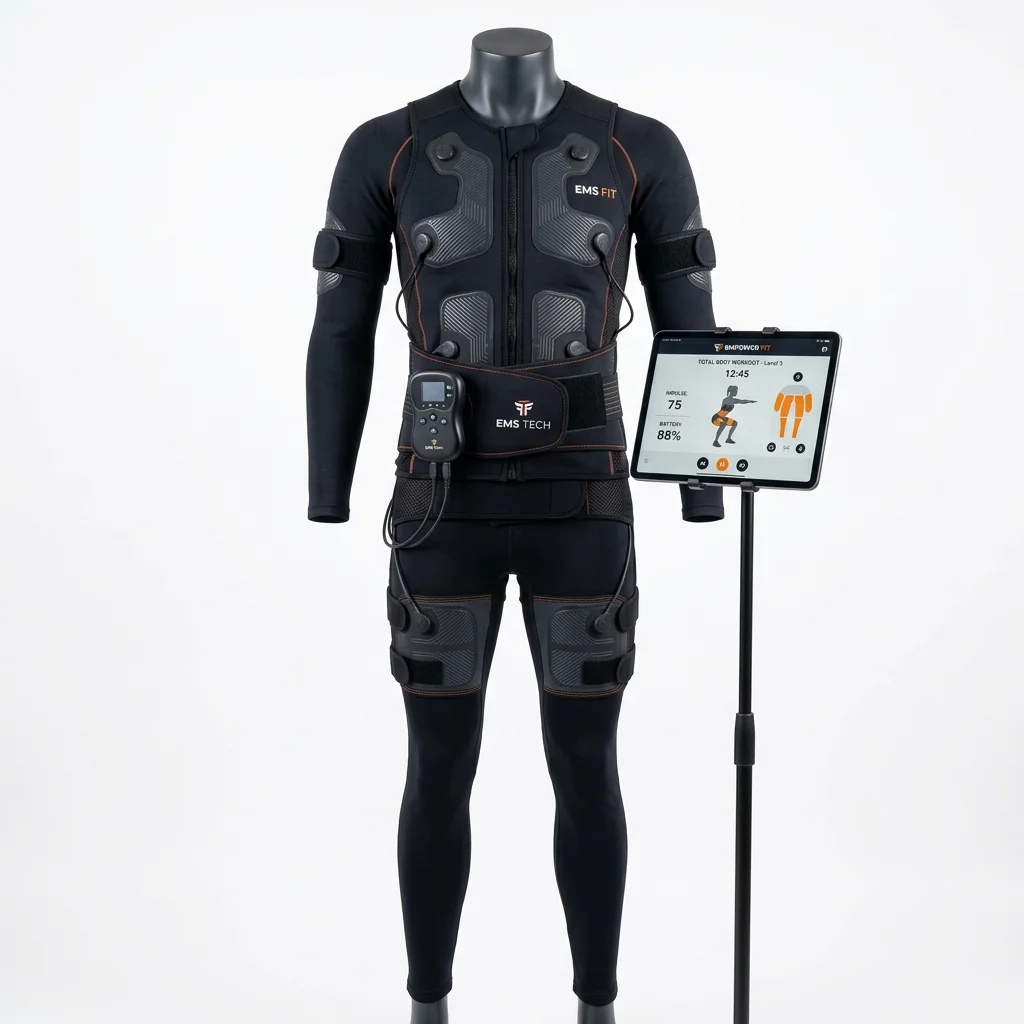
Katalyst EMS Suit
Full-body EMS training suit with 26 electrode pads, guided iPad workouts, and adaptive intensity. FDA-cleared for muscle conditioning.
Our Verdict
The most polished consumer EMS system available. The 20-minute full-body sessions deliver genuine training stimulus, and the guided iPad workouts make it approachable. Premium pricing and wet prep routine are the main trade-offs.
Last updated: May 2026
Affiliate Disclosure: BetterVitals may earn a commission from purchases made through links in this article, at no additional cost to you. This supports our independent research and analysis. We only recommend products we believe in after thorough evaluation.
Pros
- Full-body workout in just 20 minutes — genuinely time-efficient
- 26 wet electrode pads deliver strong, even stimulation across all major muscle groups
- Guided iPad workouts make it beginner-friendly with proper form cues
- FDA-cleared for muscle conditioning with automatic intensity modulation
- Portable — fits in a carrying case for travel
Cons
- Premium price: $2,999 hardware plus $29-49/month subscription
- Wet prep routine adds 5-10 minutes of setup and cleanup per session
- Requires an iPad (no iPhone or Android support)
- Not a full replacement for traditional strength training (no heavy loading)
- Subscription required — suit is unusable without active plan
Best For
- Time-constrained professionals who want effective 20-minute full-body workouts
- People with joint limitations who need low-impact muscle activation
- Fitness enthusiasts looking to supplement traditional training with EMS
- Tech-forward users who enjoy guided, app-based workout experiences
- Travelers who want a portable full-body training system
Not Ideal For
- Budget-conscious buyers — the $2,999 hardware plus subscription is a major investment
- People who dislike daily prep routines (wet electrode system adds 5-10 min per session)
- Anyone without an iPad (iPhone app is not available)
- Those with pacemakers, epilepsy, or pregnancy (EMS contraindications)
- Minimalists who prefer simple bodyweight or barbell training
In-Depth Review
How It Works
The Katalyst is a full-body electrical muscle stimulation (EMS) suit with 26 wet electrode pads covering every major muscle group — quads, hamstrings, glutes, core, chest, back, biceps, and triceps. The suit connects wirelessly to an iPad app that guides you through 20-minute workouts while modulating impulse intensity, frequency, and duration in real time.
During each session, the suit delivers low-frequency electrical impulses (typically 20-85 Hz) that cause involuntary muscle contractions layered on top of your voluntary movements. The result: your muscles work significantly harder than bodyweight exercise alone, recruiting more motor units — including fast-twitch Type II fibers that are normally difficult to activate without heavy loads.
The wet electrode system
Katalyst uses a wet-prep system: you spray each electrode pad with water before putting on the suit. This ensures consistent electrical conductivity across all 26 contact points. The prep takes 3-5 minutes and is the biggest daily friction point — but it's also why Katalyst delivers more even stimulation than dry-electrode competitors.
The iPad app
All workouts run through the Katalyst iPad app (iPhone not supported). A coach demonstrates each movement — squats, lunges, planks, bicep curls — while the suit automatically pulses at the right moments. You control intensity per muscle group using on-screen sliders, which lets you push certain areas harder or dial back if something feels too intense.
Sessions are 20 minutes, structured as strength, cardio, or recovery. The app recommends 2-3 sessions per week with at least 48 hours between sessions for recovery.
Our Testing Experience
We've been testing the Katalyst Gen 4 suit for 4 weeks. These are early impressions — we'll update this review with long-term body composition and performance data as testing continues.
Unboxing and setup is straightforward. The suit arrives in a premium case with the impulse body unit, electrode suit (top and bottom), spray bottle, and USB-C charger. Initial Bluetooth pairing with the iPad took under a minute.
First session was humbling. Even at moderate intensity (40-50% on most muscle groups), the involuntary contractions are genuinely intense. The sensation is hard to describe — it's not painful, but your muscles fire much harder than expected during what looks like a simple bodyweight squat. Our first session left us with significant DOMS (delayed onset muscle soreness) for 48 hours.
By week 2, we'd calibrated our intensity preferences per muscle group and the sessions felt productive rather than overwhelming. The guided workouts keep you moving through exercises efficiently — there's no rest between sets in the traditional sense, because the electrical impulses provide the overload while the movements keep you flowing.
Subjective results at 4 weeks: noticeably improved core engagement and muscle tone, particularly in the posterior chain (glutes, hamstrings) and core. The time efficiency is the standout — 20 minutes genuinely feels like 60+ minutes of traditional training in terms of muscular fatigue.
The not-so-great parts
The wet prep routine adds 3-5 minutes before and 5 minutes of cleanup after each session. The suit must be hung to air-dry between sessions. The iPad requirement means you need a tablet propped up at eye level during workouts. And the subscription ($29-49/month on top of $2,999 hardware) feels steep for what is essentially workout programming.
Value Analysis
At $2,999 plus a $29-49/month subscription, the Katalyst is a premium investment. Here's how we think about it:
- Time value: If you value your time at $50+/hour, replacing three 60-minute gym sessions with three 20-minute EMS sessions saves ~2 hours/week — roughly $5,200/year in time value
- Gym replacement: A premium gym membership runs $100-200/month. Katalyst's subscription is comparable, and the hardware cost amortizes over 3+ years
- Rehab/supplemental: For people who can't do heavy loading (joint issues, post-injury), EMS provides muscle activation stimulus that's otherwise unavailable
Cost per session over 2 years (assuming 3x/week): approximately $6.50/session including subscription. That's less than most boutique fitness classes.
Interested in Katalyst EMS Suit?
Check the latest pricing and availability from the official store.
View Best PriceThe Bottom Line
The Katalyst is the most polished consumer EMS system we've tested. The wet electrode system delivers consistent, strong stimulation across all muscle groups. The guided iPad workouts make it accessible for beginners. The 20-minute time commitment is genuinely transformative for busy professionals.
The main barriers are cost and the wet prep routine. If you can afford the investment and don't mind 5 minutes of setup, the Katalyst delivers a uniquely efficient training stimulus that complements (but doesn't fully replace) traditional strength training.
This is an early-impressions review based on 4 weeks of testing. We'll update with long-term body composition data and performance metrics as our testing continues.
Research & Evidence
Featured Expert
"I use Katalyst 3 times a week. It's the most time-efficient workout I've found — 20 minutes of full-body stimulation that replaces what used to take me over an hour at the gym."
Peter Diamandis
MD, Founder of XPRIZE, NYT bestselling author
Abundance360 Summit keynote
Disclosure: Dr. Diamandis is an investor in Katalyst
Effects of whole-body electromyostimulation on health and performance: a systematic review
BMC Complementary Medicine and Therapies
WB-EMS training significantly improved maximal strength, body composition, and cardiorespiratory parameters across 26 included studies.
View on PubMedWhole-body EMS training effects on body composition and muscle strength in elderly men
Frontiers in Physiology
WB-EMS applied 1.5x/week for 16 weeks significantly increased lean body mass and reduced body fat percentage compared to inactive controls.
View on PubMedTime-efficient training with whole-body electromyostimulation: effects on strength and metabolic health
European Journal of Sport Science
A 20-minute WB-EMS session 2x/week produced comparable strength gains to 60-minute conventional resistance training in untrained adults over 12 weeks.
View on PubMedFrequently Asked Questions
Common questions about this topic
Ready to try Katalyst EMS Suit?
See the latest pricing and availability.
View Best PriceAffiliate link - we may earn a commission
Compare Katalyst EMS Suit
See how Katalyst EMS Suit stacks up against the competition
Related Products
Links may be affiliate links