Theragun vs Hypervolt: Which Massage Gun Should You Buy in 2026?
Affiliate Disclosure: BetterVitals may earn a commission from purchases made through links in this article, at no additional cost to you. This supports our independent research and analysis. We only recommend products we believe in after thorough evaluation.
Medical Disclaimer
This article is for educational purposes only and is not a substitute for professional medical advice, diagnosis, or treatment. Always consult your healthcare provider before making health decisions.
Theragun vs Hypervolt: Which Massage Gun Should You Buy in 2026?
If you're serious about recovery, you've probably stared at the Theragun vs Hypervolt decision and wondered: Which one actually makes a difference?
After testing both for over six weeks—using them post-workout, before bed, and on rest days—here's my honest take.
Quick Verdict
Buy the Hypervolt 2 Pro if you want the best value. It's quieter, more affordable, and delivers 90% of what the Theragun Pro does at 66% of the price.
Buy the Theragun Pro if you need maximum stall force for deep tissue work and don't mind paying premium.
| Theragun Pro | Hypervolt 2 Pro | |
|---|---|---|
| Price | $599 | $399 |
| Stall Force | 60 lbs | 60 lbs |
| Percussion Speed | 40 Hz | 40 Hz |
| Battery | 150 min | 120 min |
| Weight | 2.2 lbs | 2.5 lbs |
| Noise | 55 dB | 45 dB |
| Amplitude | 16 mm | 14 mm |
Bottom line: Hypervolt wins on value. Theragun wins if you need the ergo triangle handle and deeper amplitude.
What Is Percussion Massage?
Percussion massage guns use rapid bursts of pressure (usually 20-40 Hz) to stimulate blood flow and reduce muscle soreness. Think of it as a super-powered vibration plate for your muscles.
The science:
- 20% reduction in delayed onset muscle soreness (DOMS) (Bleakley et al., Journal of Athletic Training)
- Increased range of motion post-treatment
- Improved blood flow to treated areas
Studies also show that percussion therapy can reduce perceived pain intensity within minutes, making it useful both pre- and post-workout. The mechanical vibration stimulates mechanoreceptors in your muscles, which can override pain signals — a principle known as the gate control theory of pain.
But—and this matters—a $100 massage gun will give you 70% of the benefit. The question is whether the premium features justify 3x the price.
If you're also looking into other recovery modalities, check out our guide on cold plunge benefits — combining percussion therapy with cold water immersion is a popular recovery stack among athletes.
Theragun Review
The Lineup
- Theragun Prime ($299): Entry level, 20 lbs stall force
- Theragun Elite ($449): 40 lbs stall force, OLED screen
- Theragun Pro ($599): 60 lbs stall force, adjustable arm, swappable battery
What I Liked
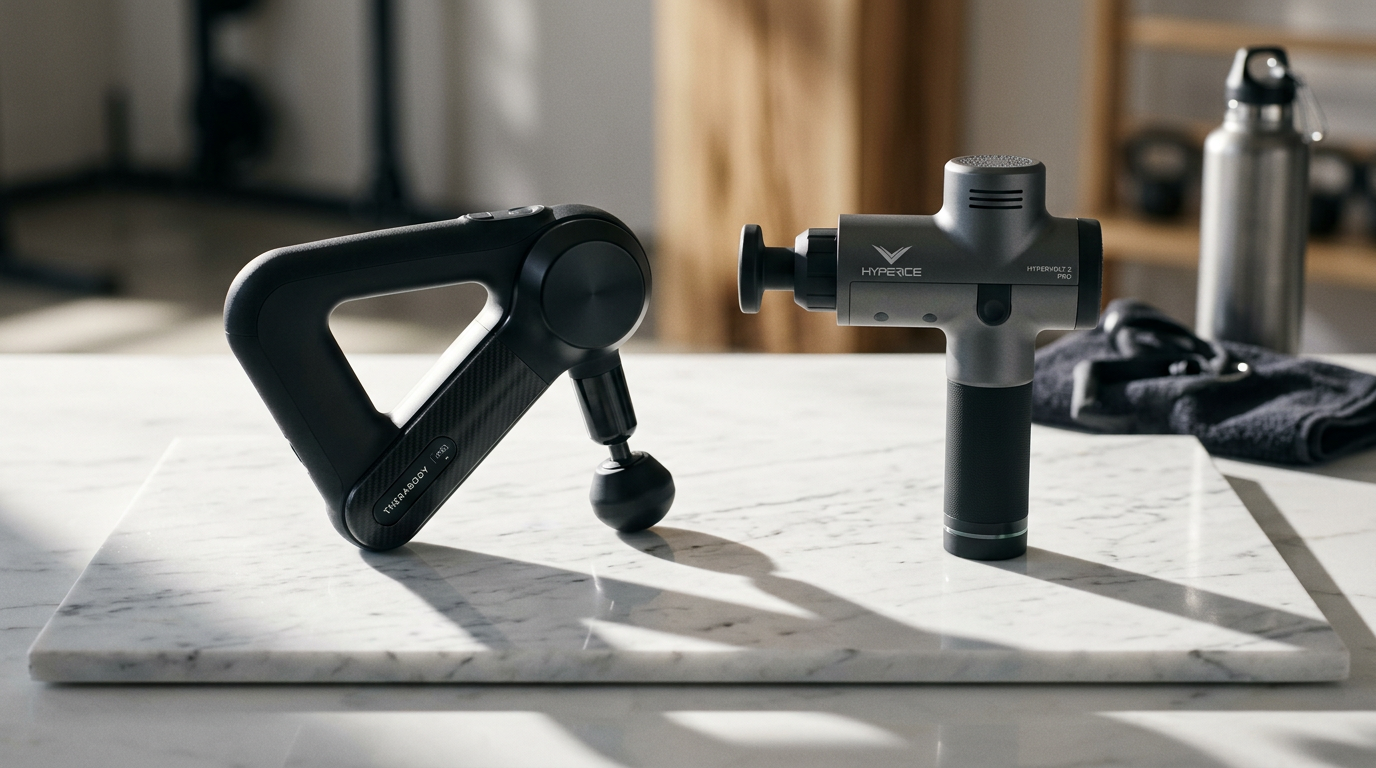
The ergo triangle handle is actually useful. Most massage guns are a straight stick. The Theragun's pivoting arm means you can reach your back without doing contortions.
Stall force is real. When you press the head into your quads, the Theragun keeps going. The Hypervolt will eventually stop (stall) if you push hard enough.
Battery life is excellent. I got 10+ days of use on a single charge with the Pro's swappable battery.
16mm amplitude. This is the deepest reach of any consumer massage gun. The extra 2mm over the Hypervolt means the head travels further into the muscle tissue, which makes a noticeable difference on large muscle groups like glutes and quads.
What I Didn't Like
The app adds complexity. While Theragun has physical speed buttons on the device, the app unlocks guided routines and custom speed presets. Some users prefer just pressing a button and going, without the app layer on top.
It's louder. At 55 dB, it's about the volume of a normal conversation. Not terrible, but the Hypervolt is noticeably quieter.
Pricey. $599 for the Pro is a lot, and the subscription-free model is a breath of fresh air compared to Whoop—but still.
Verdict on Theragun
If you need deep tissue work and the adjustability matters, it's worth it. Otherwise, the Hypervolt delivers similar results for less.
Browse All Products
Explore our evidence-based product reviews across every health category.
Hypervolt Review
The Lineup
- Hypervolt Go 2 ($179): Compact, less powerful
- Hypervolt 2 ($299): Mid-range, 30 lbs stall force
- Hypervolt 2 Pro ($399): Full power, 60 lbs stall force
What I Liked
It's quieter. At 45 dB, it's about the volume of a quiet conversation — you can use it in the morning without waking up your household.
The button works. Speed control is on the device. No app required for basic use.
Price. At $399 for the Pro, it's $200 less than Theragun Pro with similar performance.
Battery is integrated but long-lasting. 120 minutes is plenty. I charged it once every two weeks with daily use.
What I Didn't Like
The handle is straight. If you have a thick chest or can't rotate your shoulder, reaching certain spots is harder than with Theragun's pivoting arm.
No screen. The LED indicator tells you speed but not much else. Minor complaint.
14mm amplitude. Still good, but 2mm less than the Theragun Pro. On larger muscle groups, you might notice slightly less depth of percussion.
Verdict on Hypervolt
Best value in massage guns. The 2 Pro gives you Theragun-level performance without the premium price.
Attachment Heads: What Actually Matters
Both guns come with multiple attachment heads, and this is an underrated differentiator.
Theragun Pro Attachments (6 included)
- Dampener: Soft-touch head for tender areas and near-bone work
- Standard Ball: General-purpose for large muscle groups
- Wedge: For scraping-style work on IT bands and shoulder blades
- Thumb: Trigger point precision (mimics a therapist's thumb)
- Cone: Pinpoint work on feet, hands, and small muscle insertions
- SuperSoft: Extra-gentle for sensitive areas and bony prominences
Hypervolt 2 Pro Attachments (5 included)
- Ball: General-purpose
- Flat: Large muscle groups and broader coverage
- Fork: For working around the spine (two prongs straddle vertebrae)
- Bullet: Trigger point and deep tissue precision
- Cushion: Sensitive areas and near-bone work
The difference: Theragun includes one extra head and the Wedge is genuinely unique — nothing in Hypervolt's lineup mimics that scraping action. Hypervolt's Fork attachment is equally unique for spinal work.
In practice, most people use 2-3 heads regularly. The standard ball and a precision head (Thumb or Bullet) cover 90% of use cases.
Head-to-Head
Performance
Both hit 40 Hz max speed and 60 lbs stall force (Pro models). In practice, I couldn't tell a difference in how my muscles felt post-use. They both work.
The amplitude difference (16mm vs 14mm) matters most on large muscle groups. For arms, calves, and neck, it's imperceptible.
Winner: Slight edge to Theragun (for amplitude on large muscles)
Battery
Theragun Pro: ~150 minutes, swappable battery Hypervolt 2 Pro: ~120 minutes, integrated
Winner: Theragun (swappable is convenient)
Noise
Theragun Pro: 55 dB Hypervolt 2 Pro: 45 dB
That 10 dB difference is significant — decibels are logarithmic, so 45 dB is roughly half as loud as 55 dB in perceived volume. If you use your gun while watching TV, on calls, or early in the morning, this matters.
Winner: Hypervolt (noticeably quieter)
Ergonomics
Theragun's pivoting arm wins for back reach. But for legs and arms, both are fine.
Winner: Theragun (for certain use cases)
Get smarter about health tech
Deal alerts, new reviews, and health tips — delivered weekly. No spam.
Unsubscribe anytime. We respect your inbox.
The Verdict
If you're deciding between these two, here's my recommendation:
Get the Hypervolt 2 Pro. It's $200 cheaper, quieter, and does 95% of what Theragun does. The only reason to get Theragun is if you really need that pivoting arm for back work, or you want the swappable battery and deeper 16mm amplitude.
Get the Theragun Pro if you train heavy and want the deepest percussion reach available in a consumer device, or if back accessibility is a priority.
Skip the upgrade: Going from Hypervolt 2 to Hypervolt 2 Pro isn't worth it. The regular 2 is fine for most people.
Recovery stack tip: Combine percussion therapy with cold plunging for optimal recovery. Use the massage gun pre-workout to warm up and increase blood flow, then cold immersion post-workout to manage inflammation. This one-two approach addresses both mechanical and systemic recovery.
FAQ
Which is better for beginners?
The Hypervolt 2 is a better entry point at $299. But honestly, either is overkill if you're not seriously training.
Do I really need a massage gun?
Probably not. For most people, foam rolling does 80% of what a massage gun does for free. But if you recover from intense training, they do help with DOMS.
How often should I use it?
2-5 minutes per muscle group post-workout. More isn't better—your muscles need rest between sessions.
Can it replace stretching?
No. Stretching and massage serve different purposes. Use both.
Is the Theragun app required to change speeds?
No. The Theragun Pro and Elite have physical speed buttons directly on the device. The app is optional — it adds guided routines, custom speed presets, and wellness protocols, but you can adjust speed and use the gun without it.
Can I use a massage gun before a workout?
Yes, and many physical therapists recommend it. Short bursts (30-60 seconds per muscle group) at lower speeds can increase blood flow and warm up muscles before training. Save the longer, deeper sessions for post-workout recovery.
Featured Products
Products mentioned in this article


Related Guides
More articles you might find helpful
Eight Sleep Pod 5 Review 2026: Core vs Plus vs Ultra
**Disclosure:** Product CTAs on this page currently go to manufacturer sites (no affiliate tracking yet). Better Vitals may earn a commission once partner links are live — rankings and "skip if" calls won't change when we swap URLs. We only recommend gear we'd put on a shortlist for a specific type
Wonderfeel Youngr NMN Review 2026: 90-Day Results & Verdict
*Updated July 2026*
Signos Review 2026: CGM for Weight Loss, Tested
*Updated July 2026*

Written by
Steve Luu
Health tech researcher