NOVOS Age Review 2026: At-Home Biological Age Test Worth It?
Key Takeaway
Chronological age tells you how many birthdays you've had. Biological age tries to tell you how old your cells actually are — and for the longevity-curious, that second number is the one worth chasing. NOVOS Age is one of the most approachable ways to measure it from home, bundling three different r
Affiliate Disclosure: BetterVitals may earn a commission from purchases made through links in this article, at no additional cost to you. This supports our independent research and analysis. We only recommend products we believe in after thorough evaluation.
Medical Disclaimer
This article is for educational purposes only and is not a substitute for professional medical advice, diagnosis, or treatment. Always consult your healthcare provider before making health decisions.
NOVOS Age Review 2026: At-Home Biological Age Test Worth It?
Chronological age tells you how many birthdays you've had. Biological age tries to tell you how old your cells actually are — and for the longevity-curious, that second number is the one worth chasing. NOVOS Age is one of the most approachable ways to measure it from home, bundling three different readouts into a single kit and tying the results back to an actionable plan instead of leaving you with a lonely, unexplained number.
That accessibility is the whole appeal, and it's also where the honesty has to come in. Consumer biological-age testing sits in a category where the underlying science is genuinely promising but the precision of any single at-home result is not as tidy as the marketing suggests. A number that swings a few years on a retest isn't a defect unique to NOVOS — it's the nature of consumer epigenetic clocks.
We dug into what NOVOS Age actually measures, how much you can trust each of its three metrics, and how it stacks up against the more research-grade TruDiagnostic TruAge, so you can decide whether the ~$349 is buying you insight or just an interesting afternoon.
Disclosure: BetterVitals may earn a commission if you purchase through our links. This does not influence our editorial ratings. We were not paid by NOVOS, and this review is based on publicly available research.
The Short Answer
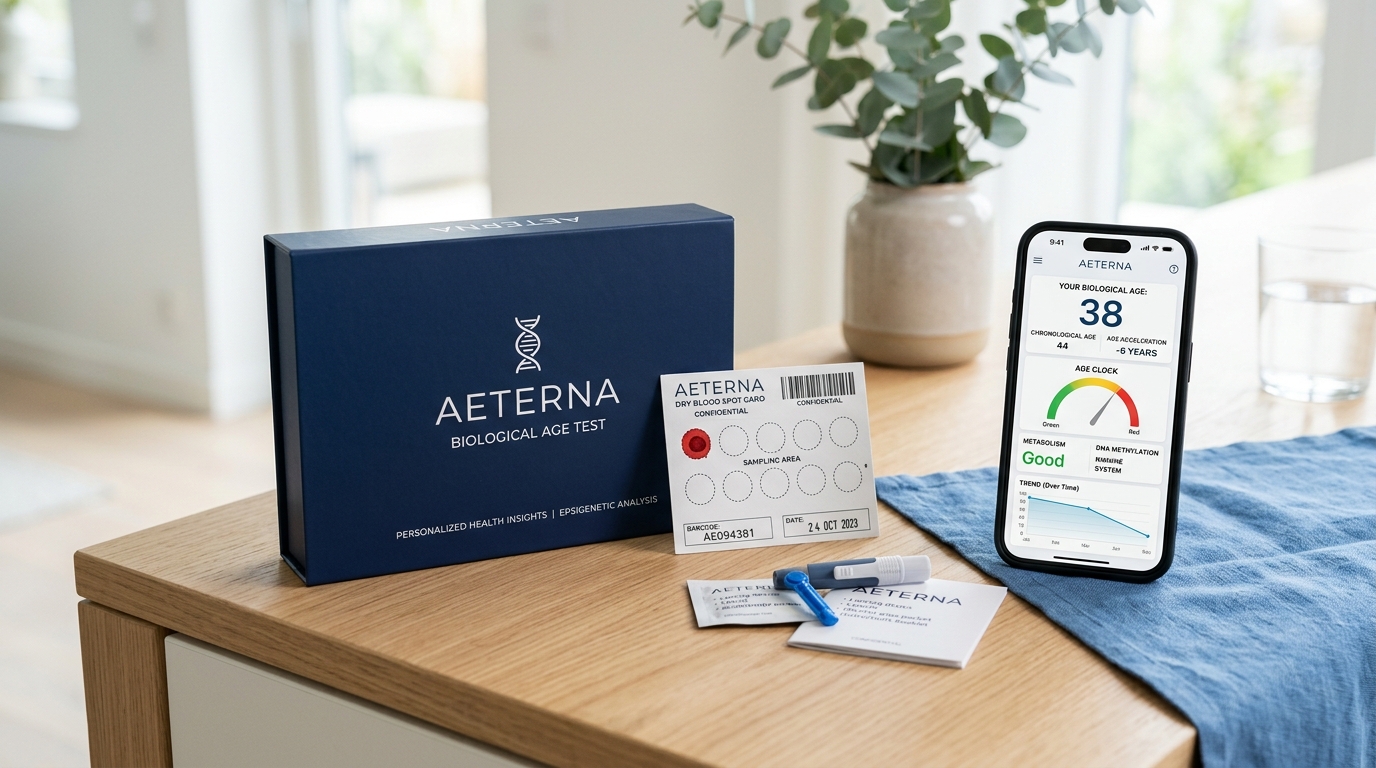
NOVOS Age is an approachable, multi-metric at-home biological age test that's most valuable when you treat it as a trend tracker, not a one-time verdict. It bundles three readouts — a DNA-methylation (epigenetic) clock from a blood sample, telomere length, and a smartphone facial scan that estimates "skin age" — and then connects those results to NOVOS's longevity recommendations so you have somewhere to go next. For accessibility and ecosystem integration, it's one of the friendlier on-ramps into biological-age testing.
The honest caveat: consumer epigenetic clocks carry meaningful test-retest variability, so a single result can shift a few years on repeat testing. That makes NOVOS Age best for watching directional change over months and years, not for pinning down a precise number today. If clock precision is your top priority, TruDiagnostic's TruAge is more scientifically rigorous. Score: 7.6/10.
What Is NOVOS Age?
NOVOS Age is an at-home biological age test from NOVOS, the longevity company better known for its NOVOS Core supplement formula. Rather than lean on a single measurement, the kit combines three distinct biological-age signals in one package: an epigenetic clock derived from DNA-methylation patterns in a blood sample, a measurement of telomere length, and a facial scan you capture with your smartphone camera that estimates the apparent age of your skin.
The idea behind bundling three metrics is that no single biomarker captures aging perfectly, so a composite picture is more informative than any one number alone. It also fits neatly into NOVOS's broader ecosystem — your results feed into the company's longevity recommendations, giving you a concrete set of lifestyle and supplement actions rather than a raw data dump.
The kit runs about $349, a one-time cost that positions it as a mainstream consumer product rather than a clinical assay. That accessibility is deliberate: NOVOS Age is designed to make biological-age testing feel doable for someone who has never sent off a blood sample before.
How It Works
The scientific centerpiece is the epigenetic clock. As you age, chemical tags called methyl groups accumulate on your DNA in predictable patterns. Researchers discovered that these DNA-methylation patterns can be read like a clock to estimate biological age, and NOVOS Age applies that principle to the blood sample you collect at home. This is the readout with the deepest scientific foundation of the three.
The second metric is telomere length. Telomeres are the protective caps on the ends of your chromosomes that shorten as cells divide, and shorter telomeres are broadly associated with aging. It's a useful complementary signal, though telomere measurements are notoriously noisy and less predictive on their own than methylation clocks.
The third component is the facial skin-age scan, captured through your phone. It uses image analysis to estimate how old your skin appears. It's the most engaging part of the experience and the easiest to repeat — but, as we'll get into, it's also the least rigorous of the three. Once all three are in, NOVOS ties the results back to its longevity recommendations so you leave with an action plan rather than just a scorecard.
The Evidence & Accuracy
Here's the distinction that matters most: the method behind the epigenetic clock is well validated, but that's not the same as validating this specific product.
The foundational science is genuinely strong. Steve Horvath's landmark 2013 paper in Genome Biology established the DNA-methylation clock as a robust, tissue-independent estimator of biological age — the paper that effectively launched the entire field (Horvath 2013). Five years later, Levine and colleagues introduced DNAm PhenoAge in Aging, a second-generation methylation clock that predicted lifespan and healthspan better than chronological age (Levine et al. 2018). Those studies underpin why epigenetic clocks are taken seriously.
But note what they validate: the epigenetic-clock approach in general, not NOVOS Age's particular implementation. That's an important line to hold. NOVOS applying a consumer-grade clock to your at-home blood sample is not the same as a research-grade array run in a lab, and the peer-reviewed literature above doesn't speak to NOVOS's specific accuracy.
Which brings us to the real limitation: test-retest variability. Consumer epigenetic clocks can return results that differ by a few years when you take the same sample or retest shortly after. This isn't fraud — it's an inherent property of reading a noisy biological signal with a consumer-tier method. The practical consequence is simple: a single NOVOS Age result is a rough estimate, not a precise verdict. The telomere measurement adds noise of its own, and the facial skin-age scan is the least rigorous component of all — fun and motivating, but not something to weigh heavily. Track the trend across multiple tests over time, and the data becomes far more meaningful than any one snapshot.
Browse All Products
Explore our evidence-based product reviews across every health category.
NOVOS Age vs TruDiagnostic TruAge
This is the comparison most serious buyers are weighing, so let's be direct about the trade-off.
| Factor | NOVOS Age | TruDiagnostic TruAge |
|---|---|---|
| Core methylation clock | Consumer-grade, less granular | Higher-resolution array, research-grade clocks |
| Extra metrics | Telomere length + facial skin-age scan | Focused on methylation depth |
| Action plan | Integrated with NOVOS longevity recs | Data-first, less prescriptive |
| Best for | Accessibility, ecosystem, multi-metric view | Scientific rigor and clock precision |
| Approach | Consumer-friendly on-ramp | Research-oriented depth |
TruDiagnostic TruAge uses a higher-resolution methylation array paired with research-grade clocks, which makes it the more scientifically rigorous choice if the precision of the epigenetic clock is your priority. It's the option for someone who wants the closest thing to lab-grade data.
NOVOS Age plays a different game. It's more consumer-friendly, it bundles extra metrics that TruAge doesn't, and it wraps everything in an integrated action plan so results turn into next steps. If you value accessibility and a guided experience over maximal clock precision, NOVOS Age is the friendlier pick. Neither is "wrong" — they optimize for different buyers.
Pricing and Value
NOVOS Age is a one-time cost of about $349, which is a significant outlay for a consumer test. That price buys you three metrics and an integrated longevity plan, so on a per-metric basis it's more generous than single-readout kits.
But here's the value logic you need to internalize: because any single result carries test-retest variability, the real payoff comes from retesting over time. A lone $349 snapshot gives you an interesting but imprecise number. Two or three tests spaced across months or years turn that into a trend line — and a trend is where the actionable insight lives. If you're only ever going to test once, you're paying premium pricing for a rough estimate.
So the honest framing is this: NOVOS Age is good value if you commit to using it as a longitudinal tracking tool alongside real lifestyle changes. If you want a one-and-done biological age reading, the cost is hard to justify relative to what a single consumer clock can reliably tell you.
Who Should Buy NOVOS Age
- Longevity beginners who want an accessible on-ramp. If you've never done biological-age testing, the guided, multi-metric experience is one of the least intimidating ways in.
- People who value an action plan over raw data. The integration with NOVOS's longevity recommendations means you leave with next steps, not just a number.
- Anyone committed to tracking trends over time. If you'll retest across months and years, the directional data becomes genuinely useful.
- Existing NOVOS ecosystem users. If you already take NOVOS Core, the test slots cleanly into the same longevity framework.
Many people pair biological-age testing with functional markers like a Jinfiniti NAD test to get a fuller picture of cellular health. Our guide to biomarkers for longevity explained covers how these readouts fit together.
Get smarter about health tech
Deal alerts, new reviews, and health tips — delivered weekly. No spam.
Unsubscribe anytime. We respect your inbox.
Who Should Skip It
- Precision-focused buyers. If you want the most granular, research-grade epigenetic clock, TruDiagnostic TruAge is the more rigorous instrument.
- One-time testers. If you won't retest, you're paying $349 for a single imprecise snapshot — poor value for what a consumer clock can reliably deliver.
- Anyone expecting a definitive verdict. Test-retest variability means the number is a rough estimate, not a precise judgment of how old your cells are.
- Bargain hunters. This is a premium-priced consumer test, and the facial-scan component in particular shouldn't be a reason to buy.
The Verdict: 7.6/10
NOVOS Age earns a solid score by doing something valuable: it makes biological-age testing approachable, bundles three complementary metrics, and — crucially — hands you an action plan instead of an unexplained number. For accessibility and ecosystem integration, it's one of the friendliest entry points into a field that usually feels intimidating and clinical.
The reason it isn't higher is the same reason you should go in with clear eyes. The consumer epigenetic clock is less granular than TruDiagnostic's, telomere and facial-scan readings add noise, and test-retest variability means no single result is a precise verdict. Treat it as a trend tracker you commit to over time, pair it with real lifestyle change, and it's a worthwhile tool. Buy it expecting a one-time definitive answer, and you'll be disappointed. Track the trend, not the number.
Frequently Asked Questions
Is NOVOS Age accurate?
NOVOS Age is reasonably accurate for tracking directional change over time, but any single result carries meaningful test-retest variability and can shift a few years on a repeat test. That's inherent to consumer epigenetic clocks, not a flaw unique to NOVOS. Treat it as a rough estimate you refine through repeated testing rather than a precise one-time verdict.
What does NOVOS Age actually measure?
It measures three things: a DNA-methylation (epigenetic) clock from a blood sample, telomere length, and a smartphone facial scan that estimates your "skin age." The epigenetic clock has the strongest scientific foundation, while the facial-scan skin-age feature is the most engaging but least rigorous component. Together they give a composite picture rather than relying on one biomarker.
NOVOS Age vs TruDiagnostic TruAge — which is better?
TruDiagnostic TruAge is more scientifically rigorous, using a higher-resolution methylation array and research-grade clocks, so it's the better choice if clock precision is your priority. NOVOS Age is more consumer-friendly, bundles extra metrics like telomeres and a facial scan, and ties results to an integrated action plan. Choose TruAge for rigor and NOVOS Age for accessibility and guidance.
Are epigenetic clocks scientifically validated?
The epigenetic-clock method is well validated in peer-reviewed research — Horvath's 2013 paper established DNA methylation as a robust biological-age estimator, and Levine's 2018 DNAm PhenoAge clock predicted lifespan and healthspan. Those studies validate the general approach, however, not NOVOS Age's specific consumer implementation. A validated method run at consumer grade still carries more variability than a research-grade lab assay.
How often should I test with NOVOS Age?
Because a single result is imprecise, the value comes from retesting over time to build a trend line. Testing roughly every six to twelve months, alongside genuine lifestyle changes, lets you see directional movement rather than reacting to noise. One-time testing is the least useful — and least cost-effective — way to use it.
Is NOVOS Age worth $349?
It's worth it if you commit to using it as a longitudinal tracking tool alongside real lifestyle changes, since the trend is where the actionable insight lives. If you only plan to test once, $349 for a single imprecise snapshot is hard to justify. Value hinges entirely on retesting over time rather than treating the first number as a verdict.
Featured Products
Products mentioned in this article

Related Guides
More articles you might find helpful
Eight Sleep Pod 5 Review 2026: Core vs Plus vs Ultra
**Disclosure:** Product CTAs on this page currently go to manufacturer sites (no affiliate tracking yet). Better Vitals may earn a commission once partner links are live — rankings and "skip if" calls won't change when we swap URLs. We only recommend gear we'd put on a shortlist for a specific type
Wonderfeel Youngr NMN Review 2026: 90-Day Results & Verdict
*Updated July 2026*
Signos Review 2026: CGM for Weight Loss, Tested
*Updated July 2026*

Written by
Steve Luu
Health tech researcher