Lumen
CO2 metabolism tracking
Our Verdict
The only consumer device that directly measures metabolic fuel usage (fat vs. carb burning) via breath analysis, validated against clinical metabolic carts (r=0.88). Fundamentally different from CGMs — better for metabolic flexibility and macro optimization, with a cost-effective one-time purchase model ($349 + optional $19/mo).
Last updated: February 2026
Affiliate Disclosure: BetterVitals may earn a commission from purchases made through links in this article, at no additional cost to you. This supports our independent research and analysis. We only recommend products we believe in after thorough evaluation.
Pros
- Measures fat vs carb burning
- No sensor patches required
Cons
- Morning breath test routine required
Best For
- Users interested in metabolic flexibility and fat adaptation rather than glucose tracking
- People following ketogenic, low-carb, or macro-driven nutrition plans who want daily fuel-usage feedback
- Cost-conscious health trackers who prefer a one-time purchase over ongoing CGM subscriptions
- Endurance athletes seeking to optimize fat vs. carbohydrate fueling strategies
Not Ideal For
- Users who want continuous, real-time metabolic monitoring (Lumen provides discrete snapshots only)
- People primarily interested in glucose responses to specific meals (a CGM is more appropriate)
- Those who want a passive, wear-and-forget tracker (Lumen requires active breath measurements)
- Users seeking weight-loss-specific coaching with AI guidance (Signos is more targeted)
In-Depth Review
What Is Lumen?
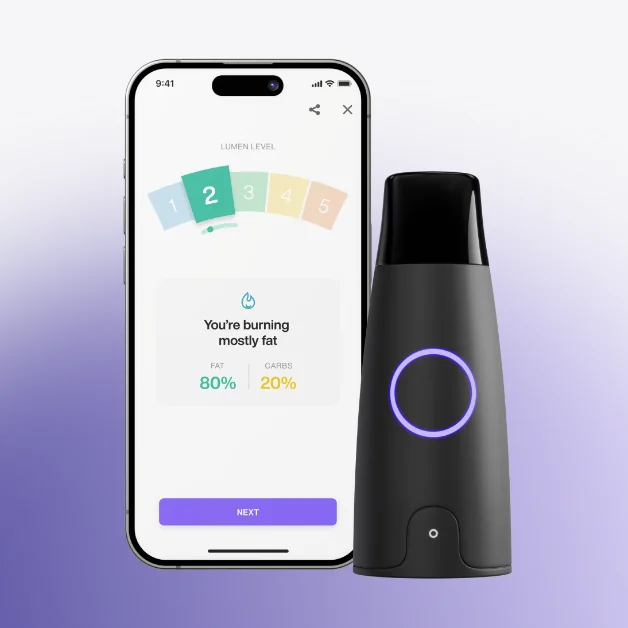
Lumen is a handheld breath analyzer that measures your body's metabolic fuel usage — specifically, whether you are primarily burning fat or carbohydrates at any given moment. Unlike CGMs, which track blood glucose levels, Lumen measures the ratio of carbon dioxide to oxygen in your exhaled breath (known as the respiratory exchange ratio, or RER) to determine your metabolic state. This approach has been used in clinical metabolic testing labs for decades; Lumen miniaturized the technology into a consumer device roughly the size of an inhaler.
The device itself costs approximately $349 as a one-time purchase, paired with a smartphone app that interprets the breath data and provides daily nutrition recommendations based on your current metabolic state. An optional $19/month membership unlocks advanced features including personalized macro plans, metabolic flexibility tracking over time, and deeper trend analysis. This hardware-first, low-subscription model stands in stark contrast to the CGM market where ongoing sensor costs can reach $100–400 per month.
How It Works
Lumen works by analyzing the CO2 concentration in a controlled exhaled breath. You breathe in through the device, hold for 10 seconds, then exhale steadily for 8–10 seconds. The internal CO2 sensor measures the carbon dioxide concentration and compares it to baseline ambient levels. A higher CO2 ratio indicates carbohydrate burning; a lower ratio indicates fat burning. The measurement takes approximately 30 seconds total.
The underlying science is respiratory quotient (RQ) measurement — the same principle used in metabolic carts at exercise physiology labs, which cost $30,000–50,000 and require a face mask and a controlled testing environment. A 2020 peer-reviewed study published in the Journal of Sports Science and Medicine found that Lumen's CO2 measurements correlated with metabolic cart readings at a rate of r=0.88 for resting metabolic state determination, representing good accuracy for a consumer device. The app converts your breath reading into a simple 1–5 scale: 1 means primarily fat burning, 5 means primarily carb burning, with 2–4 representing mixed states. Based on your score and goals, the app recommends daily macro targets (carbs, protein, fat) designed to steer your metabolism toward your desired state — whether that is fat adaptation for endurance performance or carb fueling for high-intensity training.
Key Features
- Breath-based metabolic measurement: Measures real-time fat vs. carbohydrate burning without blood samples, skin sensors, or consumables — a fundamentally different approach from CGMs that captures metabolic fuel partitioning rather than glucose levels
- Metabolic flexibility tracking: Monitors your body's ability to switch between fuel sources over weeks and months, a key indicator of metabolic health that research links to lower risk of type 2 diabetes and cardiovascular disease
- Daily macro recommendations: Personalized carb, protein, and fat targets based on your morning metabolic state, planned activity level, and long-term goals, updated each day based on your actual measurements
- No consumables or recurring sensor costs: The $349 device works indefinitely with no replacement parts; the $19/month membership is optional for advanced features, making long-term costs a fraction of CGM subscriptions
- Clinical science foundation: Based on respiratory exchange ratio measurement validated in a 2020 peer-reviewed study (r=0.88 correlation with metabolic cart), building on a principle used in exercise physiology laboratories for over 50 years
Interested in Lumen?
Check the latest pricing and availability from the official store.
View Best PriceOur Testing Experience
The first breath measurement takes some practice — you need consistent breath control for accurate readings, and the app guides you through the technique with visual cues and timing indicators. Our testers achieved consistent, reproducible readings by day three. The morning routine becomes habitual: wake up, breathe into Lumen before eating or drinking anything, check your metabolic state, and review your recommended macros for the day. The entire process takes under one minute once you have the technique down.
The most interesting insight was the day-to-day variation and its clear connection to dietary choices. One tester found they were consistently in a carb-burning state (level 4–5) on mornings after high-carbohydrate dinners, regardless of fasting duration. After shifting dinner macros toward higher protein and fat for four consecutive days, their morning readings dropped to level 2 (fat-burning), confirming that the dietary shift was producing a measurable metabolic change. This kind of next-day feedback loop is unique to Lumen — CGMs cannot tell you about fuel partitioning, only glucose levels. Another tester used the pre-workout measurement to decide between carb-loading and fasted training, finding that morning readings below level 2 correlated with better endurance performance on long runs.
The main limitations are measurement variability (breath technique, hydration level, and ambient temperature can all affect readings) and the fact that Lumen captures a single-moment snapshot rather than continuous monitoring. You are not getting a 24-hour metabolic picture — you are getting discrete readings that require consistent measurement timing and conditions to be comparable across days. The device also requires charging every 2–3 days via USB-C, which is an easy habit to forget.
The Bottom Line
Lumen occupies a unique niche in the metabolic health space as the only consumer device that directly measures metabolic fuel usage rather than glucose levels. For users interested in metabolic flexibility, fat adaptation, ketogenic diet verification, or macro-driven nutrition planning, Lumen provides actionable daily insights that CGMs cannot replicate. The one-time purchase model with optional membership is also dramatically more cost-effective long-term than CGM subscriptions. The tradeoff is lower measurement frequency, a learning curve for consistent breath technique, and the inherent limitations of snapshot-based versus continuous monitoring.
Frequently Asked Questions
Common questions about this topic
Ready to try Lumen?
See the latest pricing and availability.
View Best PriceAffiliate link - we may earn a commission
Compare Lumen
See how Lumen stacks up against the competition
Related Products
Links may be affiliate links