Levels Health vs Abbott Lingo: Which Is Better in 2026?

The Verdict

For most people trying continuous glucose monitoring for the first time, we'd point them to Abbott Lingo. At roughly $49 a month it costs a fraction of a full Levels setup, it's sold over the counter with no prescription logistics, and it's the only consumer sensor in this comparison that also tracks ketones — a genuinely useful feature if you're experimenting with keto or fasting. Levels wins on software, not hardware. Its Zone Score meal grading and food-glucose correlation tools are the deepest in the category, but you pay for that depth twice: a $199/month software subscription plus $75–150/month for sensors. That combined cost only makes sense if you'll actually use the analysis — logging meals consistently and acting on the patterns. If you're a data-literate self-optimizer who wants software that interprets your glucose data for you, Levels justifies its price. If you mainly want to see your glucose (and ketone) response to food without a heavy monthly commitment, Lingo is the smarter starting point.

How They Compare in Practice

The day-to-day difference here is mostly about what the app does with your data, not the sensor on your arm. Lingo uses Abbott's proven Libre biosensor family, and Levels also relies on third-party sensors — so the raw glucose readings come from established hardware either way. Consumer CGMs are directional tools for non-diabetics: expect them to be reliable for spotting spikes and trends, not for exact single-number precision.

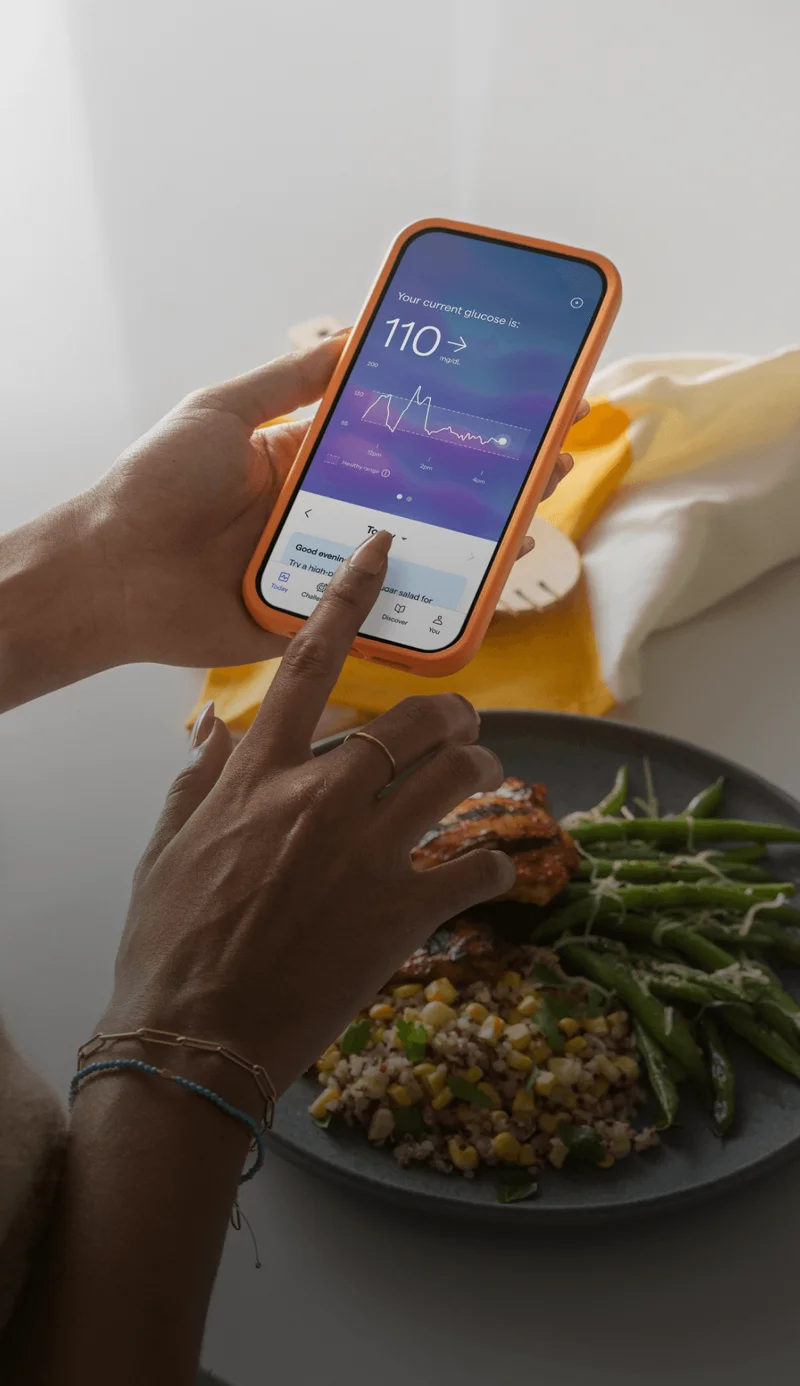
Where Levels pulls ahead is meal scoring. Log a meal and the app grades your glucose response with its Zone Score, then builds a personal library of how specific foods affect you. Lingo's app is more interpretive than a bare-bones tracker, but it doesn't attempt that level of AI-driven food analysis. What Lingo does that Levels can't: continuous ketone confirmation, which matters if you want to verify nutritional ketosis without fingerstick strips.

Levels Abbott Lingo
Monthly cost $199 software + $75–150 sensors ~$49
Measures Glucose Glucose + ketones
Access Involves prescription logistics Over the counter
App focus Meal scoring, deep analysis Simplified tracking

Over six months, that cost gap is well over $1,000 — worth keeping front of mind.

Which Should You Choose?

Choose Levels if you're a self-directed optimizer who will log meals diligently and wants the deepest food-glucose correlation software available — and the $275–350/month combined cost fits your budget.

Choose Abbott Lingo if you want an affordable, no-prescription way to see how food affects your glucose, or you're doing keto or intermittent fasting and want ketone tracking from the same sensor — something no other consumer CGM here offers.

Choose neither if what you really want is human guidance: neither includes a dietitian, so a coached platform like Nutrisense may serve you better.

One honest caveat: many people learn their main food triggers within a few months of CGM use, so a lower-cost entry point like Lingo lets you test whether the data changes your behavior before committing to a premium platform. Both are legitimate tools — they simply sit at opposite ends of the price-versus-software-depth spectrum.

Affiliate Disclosure: BetterVitals may earn a commission from purchases made through links in this article, at no additional cost to you. This supports our independent research and analysis. We only recommend products we believe in after thorough evaluation.

Levels Health
MINIMALIST
9.4/10
$$~$199
2 Studies2 Experts
Abbott Lingo
ENTRY LEVEL
8/10
$~$49

Pros & Cons Comparison

Levels Health

Pros

  • Daily metabolic stability score
  • Seamless Apple Health sync

Cons

  • Waitlist may delay access

Abbott Lingo

Pros

  • Simplified "Lingo count" metric
  • Most affordable CGM option

Cons

  • Less detailed data than competitors

Who Should Choose Which?

Levels Health

Best For

  • Self-directed biohackers who want granular food-glucose correlation data
  • Data-literate users comfortable interpreting metabolic trends without a dietitian
  • People seeking to optimize energy and body composition through personalized nutrition
  • Athletes or performance-focused individuals tracking how diet affects training recovery

Not Ideal For

  • Budget-conscious users — total monthly cost (software + sensor) ranges from $275 to $350
  • Those who prefer guided nutrition coaching (Nutrisense includes a dietitian)
  • People who want an OTC experience without prescription logistics (consider Dexcom Stelo)
  • Users looking for weight-loss-specific programming (Signos is more targeted)

Abbott Lingo

Best For

  • Ketogenic dieters and intermittent fasters who want continuous ketone confirmation without fingerstick strips
  • Cost-conscious users seeking the most affordable OTC CGM with meaningful app insights
  • People who want dual glucose and ketone tracking from a single sensor
  • Users looking for more interpretive features than the Dexcom Stelo at a lower price

Not Ideal For

  • Users who want guided coaching or dietitian support (Nutrisense or Signos are better)
  • Those seeking the most clinically established CGM brand (Dexcom Stelo has a longer medical track record)
  • People who need deep meal scoring and AI-powered food optimization (Levels offers more software depth)
  • Users who want extensive third-party app integrations for data export and analysis

Evidence Comparison

Levels Health

Published Studies2
Expert Endorsements2
Podcast Mentions1
Third-Party Tests4

Abbott Lingo

No evidence data available

Levels Health

$$ (~$199)

Check Best Price

Affiliate link - we may earn a commission

Abbott Lingo

$ (~$49)

Check Best Price

Affiliate link - we may earn a commission

Not sure which is right for you?

Take our personalized metabolic assessment to get a tailored recommendation based on your needs and preferences.

Frequently Asked Questions

Common questions about this topic

Levels provides the most intuitive CGM software on the market, with Zone Scores, detailed metabolic reports, and seamless food-glucose correlation. However, the $199/month covers software only — sensors cost an additional $75–150/month. If you are metabolically healthy and seeking to optimize performance or body composition through food choices, the first 2–3 months typically deliver the most actionable insights. Many users find they can identify their key food triggers within that window and discontinue. For ongoing monitoring, Nutrisense ($225–399/mo) includes a dietitian, and Dexcom Stelo ($99/mo) offers raw glucose data at a lower price point.
Levels ($199/mo software-only) excels at self-directed metabolic exploration with its Zone Score system and clean app interface. Nutrisense ($225–399/mo) includes a CGM sensor and registered dietitian consultations, making it better for users who want professional interpretation of their data. Levels requires more self-education but offers more granular food-scoring tools. If you prefer expert guidance, choose Nutrisense. If you are comfortable interpreting data independently and want the most polished software experience, Levels is the stronger choice.
The primary limitations are: high total cost when combining software ($199/mo) and sensors ($75–150/mo); no included dietitian or nutritionist consultations; CGM sensors must be sourced separately through Levels' pharmacy network, which can introduce shipping delays; and the prescription process, while streamlined, adds a layer of complexity that OTC options like Dexcom Stelo avoid entirely. Additionally, some users experience data fatigue after the initial novelty, and the insights plateau once major food triggers are identified.
Levels' partner pharmacy handles the prescription process as part of onboarding. You complete a brief health questionnaire, and a licensed provider reviews and approves it — typically within 24–48 hours. You do not need to visit your own doctor. However, if you prefer a fully over-the-counter experience with no prescription step, Dexcom Stelo and Abbott Lingo are available without any prescription requirement.
Most users report the highest density of actionable insights during the first 4–8 weeks, when they are discovering personal glucose responses to their regular foods. By month two, most people have identified their top spike-causing foods and developed stable meal templates. Some users continue beyond this for ongoing accountability, while others discontinue and use what they learned. Levels does not require a long-term commitment — you can cancel monthly — but the Zone Score system tends to lose novelty after the initial learning phase.
At $49/month, the Lingo is the most affordable continuous metabolic monitor available and the only one that tracks both glucose and ketones. Compared to Dexcom Stelo ($99/mo, glucose only) and subscription platforms ($199–399/mo), the Lingo offers strong value — especially for users who also want ketone data. The app provides more interpretive depth than the Stelo but less than Levels or Nutrisense. If you want affordable, dual-analyte monitoring with personalized insights, the Lingo is the best option in its price range.
Both are OTC CGMs requiring no prescription. The Lingo ($49/mo) uses Abbott's Libre biosensor with 14-day wear and tracks both glucose and ketones; the Stelo ($99/mo) uses Dexcom's G7-based sensor with 15-day wear and tracks glucose only. The Lingo's app offers more interpretive features (food response scoring, daily summaries) than the Stelo's minimal interface. The Stelo has Dexcom's stronger clinical CGM reputation and a slightly shorter 30-minute warm-up vs. the Lingo's 60 minutes. For most consumers, the Lingo offers more features at a lower price.
The primary limitations are: the 60-minute warm-up period after sensor application (vs. 30 minutes for Dexcom Stelo); a less established brand presence in the consumer wellness market compared to Dexcom; limited third-party app integrations and no native data sharing with platforms like Levels or Nutrisense; and while the app is more developed than the Stelo's, it still lacks the depth of subscription platforms' meal scoring and AI coaching features. Ketone readings also require periodic calibration through the app.
The Lingo's ketone tracking uses the same interstitial fluid measurement approach as its glucose sensing, built on Abbott's Libre sensor platform. In our testing, BHB readings correlated well with fingerstick ketone meter measurements, typically within 0.1–0.2 mmol/L. The continuous nature of the readings is the real advantage — rather than single fingerstick snapshots, you see how ketone levels fluctuate throughout the day in response to meals, fasting windows, and exercise. This is particularly valuable for confirming sustained nutritional ketosis.
The Lingo provides glucose and ketone data that can inform weight loss decisions, but it does not offer weight-loss-specific coaching like Signos. You can use the glucose data to identify high-spike meals and the ketone data to confirm fat-burning states, but the interpretation and action planning are up to you. For a dedicated CGM-based weight loss program with AI coaching, Signos is more targeted. The Lingo is better suited as an affordable monitoring tool for users who already have a diet plan and want metabolic feedback.

Related Comparisons

See how these products compare to others in the same category

BetterVitals

Honest reviews and personalized quizzes to help you find the right health tech.

Medical Disclaimer: The content on BetterVitals is for informational and educational purposes only. It is not intended as medical advice, diagnosis, or treatment. Always consult with qualified healthcare professionals before making decisions about your health, supplements, or medical devices. Individual results may vary.

Popular:···

© 2026 BetterVitals. All rights reserved.