AirDoctor 3500 vs AquaTru Countertop RO: Which Is Better in 2026?
The Verdict
We should say this clearly: the AirDoctor 3500 and the AquaTru Countertop RO do not compete with each other. One purifies the air you breathe; the other purifies the water you drink. They represent two different pillars of a healthy home environment, and the honest question is not which is better but which to prioritize first.
Our general guidance: let your environment decide. If you live near a highway, in a wildfire-prone or high-pollution area, or someone in your home has allergies or asthma, air quality is likely your bigger lever — the AirDoctor's UltraHEPA filtration, which captures particles far smaller than standard HEPA handles, is built exactly for that, covering spaces up to 1,274 sq ft for $629. If your concern is what is in your tap water — PFAS, lead, fluoride — the AquaTru's NSF-certified 4-stage reverse osmosis, verified against 80+ contaminants for $449 with no installation, is the more direct answer.
Both score within a tenth of a point in our reviews. Households that can eventually justify both usually should; the order just depends on your local risks.
How They Compare in Practice
Day to day, these serve completely different roles, so we will compare ownership experience rather than head-to-head performance.
The AirDoctor 3500 runs continuously in the background. Its UltraHEPA filter targets ultrafine particles well below what standard HEPA captures, and its CADR supports large spaces up to 1,274 sq ft. The practical tradeoffs: it is not whisper-quiet at higher fan speeds, and there is no Wi-Fi or app control — you operate it from the unit itself, which smart-home households may find dated. Ongoing cost is reasonable at roughly $70–100/year in replacement filters.
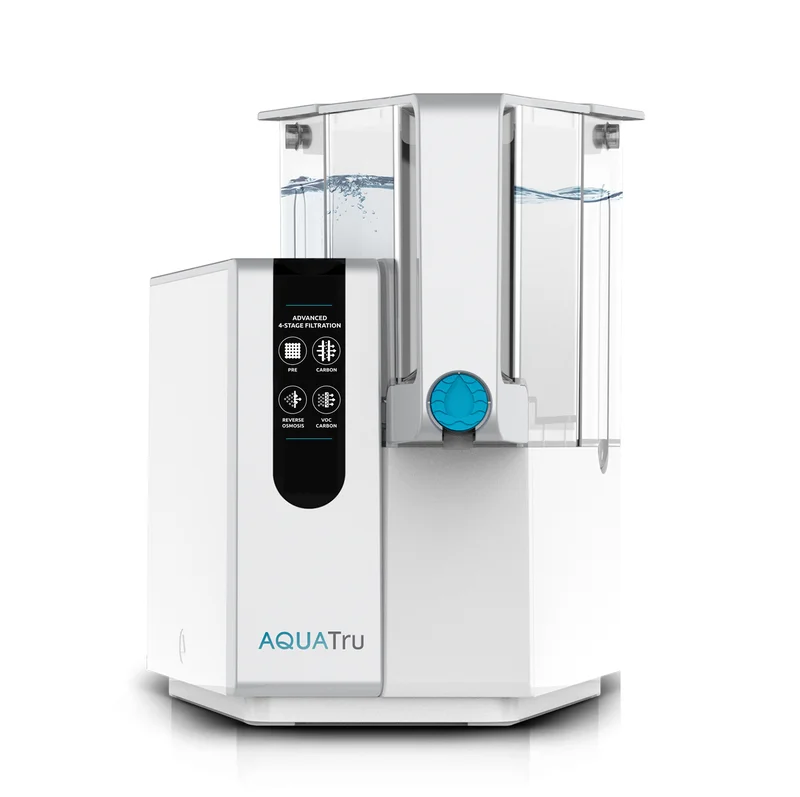
The AquaTru Countertop RO is an active-use appliance: you fill its tank, the 4-stage reverse osmosis process runs, and you dispense purified water. Its standout trait is verification — NSF/ANSI certification across five standards, with tested removal of fluoride, lead, PFAS, and 80+ contaminants. Practical tradeoffs: the 3-quart tank needs frequent refilling in larger households, it requires electricity, and RO strips beneficial minerals along with contaminants, so some users add minerals back separately.
| AirDoctor 3500 | AquaTru Countertop | |
|---|---|---|
| Pillar | Air quality | Water quality |
| Price | $629 | $449 |
| Coverage | Up to 1,274 sq ft | 3-quart tank per cycle |
| Standout | UltraHEPA depth | Five NSF/ANSI certifications |
Both demand filter replacements to keep performing — budget for consumables either way.
Which Should You Choose?
Prioritize the AirDoctor 3500 if anyone in your household has allergies or asthma, you live near traffic or in a region with wildfire smoke or elevated pollution, or you simply spend most of your time indoors in a large space. Airborne exposure is continuous — you breathe your indoor air all day — so in high-particulate environments it is usually the first pillar to address.
Prioritize the AquaTru Countertop if your municipal water report (or local news) raises PFAS or lead concerns, you are a renter who cannot install an under-sink system, or third-party certification is what earns your trust. At $449 it is also the lower-cost entry point of the two.
Get both over time if you are building a comprehensive healthy-home setup — they address independent risks and neither substitutes for the other.
Skip or downsize if your needs are modest: a small bedroom needs only a compact HEPA unit, and basic chlorine-and-taste water concerns are handled by a far cheaper pitcher filter. These are deep-filtration tools for people with real exposure concerns, not defaults for every household.
Affiliate Disclosure: BetterVitals may earn a commission from purchases made through links in this article, at no additional cost to you. This supports our independent research and analysis. We only recommend products we believe in after thorough evaluation.

Pros & Cons Comparison
AirDoctor 3500
Pros
- UltraHEPA captures 99.99% particles
- Whisper-quiet auto-mode
Cons
- Filter replacements add ongoing cost
AquaTru Countertop RO
Pros
- NSF certified 4-stage filtration
- No installation required
Cons
- Wastes some water in RO process
Who Should Choose Which?
AirDoctor 3500
Best For
- Health-conscious households prioritizing the deepest available particulate filtration
- Allergy and asthma sufferers who need filtration beyond standard HEPA capability
- Large living spaces up to 1,274 sq ft that need high CADR air cycling
- Homes near highways or in high-pollution areas where ultrafine particles are a concern
Not Ideal For
- Users who want smart home integration or app-based controls (no Wi-Fi connectivity)
- Small rooms where a compact, less expensive HEPA purifier would suffice
- Budget buyers seeking basic air filtration under $300
- Those who prioritize whisper-quiet operation at all fan speeds
AquaTru Countertop RO
Best For
- Health-conscious households wanting NSF-certified removal of fluoride, lead, and PFAS
- Renters or homeowners who cannot install under-sink reverse osmosis systems
- Families concerned about PFAS contamination in municipal water supplies
- Users who prioritize third-party certification and verified contaminant reduction claims
Not Ideal For
- Off-grid or emergency preparedness users who need electricity-free filtration (Berkey is better suited)
- Users who want to retain beneficial minerals without adding them back separately
- Large families needing high-volume filtered water on demand (3-quart tank requires frequent refilling)
- Budget buyers looking for basic chlorine and taste filtration (a Brita is far less expensive)
Frequently Asked Questions
Common questions about this topic
Related Comparisons
More comparisons coming soon